
Mining Investor Readiness: Preparing a Project for Capital
Many mining projects reach investors before they are ready. Mining investor readiness means evidence an institutional reader can test, prepared before any approach to capital.
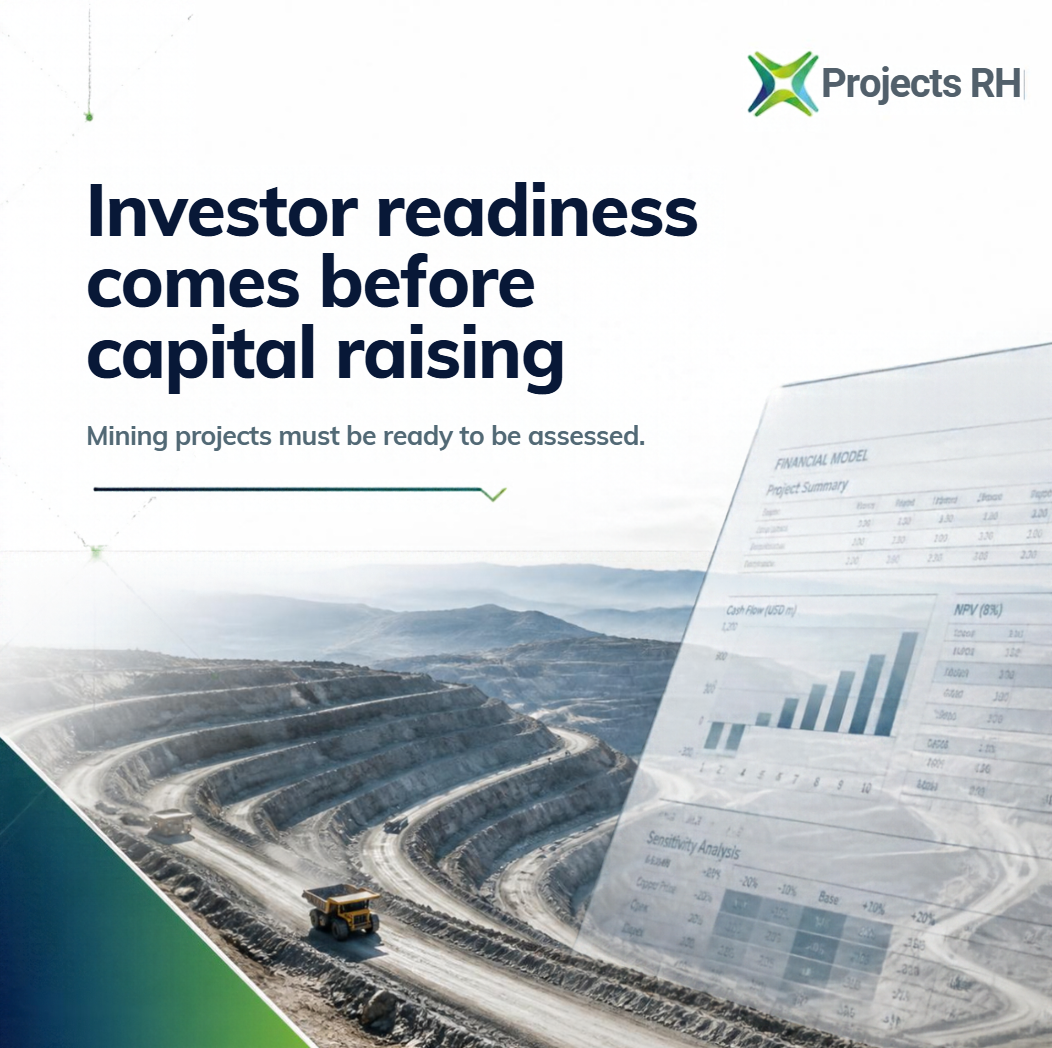
Many Mining Investor Readiness reach investors before they are ready. The geology may be promising and the sponsor may be committed, but the evidence is scattered, the model has not been tested and the documents do not agree with each other. Investor readiness is the work that fixes this. It establishes the facts, builds or tests the financial model and prepares documentation that an institutional reader can test. In mining, where capital needs are large and much of the evidence is technical, that work comes before any approach to funding.
What investor readiness means for a mining project
Most projects do not need investors first. They need to become investor-ready.
For a Mining Investor Readiness, that means an investor or lender can pick up your materials and check them. Every figure traces back to a source. Every claim about the deposit, the permits or the costs is supported by a document in the data room. The financial model, the memorandum and the deck tell the same story with the same numbers.
Investor readiness is not a promise that money will follow. It is the point at which a project can be read properly by the people who might fund it. Whether they choose to fund it is their decision, made on their own terms.
Why mining projects reach investors too early
Mining projects are long, technical and expensive. Exploration, study work, permitting and construction can stretch across years, and each stage produces its own reports from its own specialists. By the time a sponsor wants to raise capital, the information often sits in many places: consultants' studies, government correspondence, spreadsheets built for different purposes, and the knowledge of the people who have lived with the project.
The temptation is to go to market with what exists and tidy it up later. The difficulty is that institutional readers tend to find the gaps first. A cost estimate that does not match the model, a permit whose status is unclear or a resource figure quoted without its basis can stall a conversation before it has started.
Capital raising readiness is about finding those gaps yourself, while you still control the timetable, rather than having an investor find them for you.
The evidence an institutional reader will test
Every project is different, and the questions depend on the commodity, the jurisdiction, the stage and the type of capital sought. Even so, institutional readers looking at a mining project commonly want to understand:
- the resource or reserve position, who prepared it and under which reporting standard
- the metallurgical and processing work behind the planned recovery
- tenure, permits and approvals, and where each one stands
- capital and operating cost estimates, and the level of study behind them
- the commodity price and exchange rate assumptions the case rests on
- access to power, water, transport and the route to market, including any offtake arrangements
- environmental, social and closure obligations
- the sponsor, the management team and who is responsible for delivery
None of this is unusual. What matters is that the evidence exists, that it is organised and that the financial case uses it consistently. Project preparation is the discipline of bringing those pieces together before the first investor asks.
Five documents that agree with each other
Projects RH prepares capital-intensive projects for institutional review. The work produces five documents that agree with each other, each reviewed by a professional:
- Financial model. The single point of truth for every figure the other documents use. For a mining project, a financial model for capital raising has to carry the production profile, the costs and the assumptions in a way a reader can follow and test.
- Information memorandum. The written investment case: the business, the plan, the structure and the risks.
- Investor deck. The short form of the same case, for the first meeting.
- Teaser. The summary that goes out before identity does.
- Data room. Contracts, permits, financials and diligence materials, organised before the first investor asks.
The point is consistency. If the information memorandum quotes one capital cost and the model uses another, an investor will notice. When every document draws its numbers from the same model, the case holds together under questioning, whether the conversation is about equity, debt or project finance.
Preparation first, capital raising second
Projects RH separates the two pieces of work. Preparation is professional work: establishing the facts, building the financial foundation, preparing the documentation and defining the transaction pathway. Capital raising follows only under a separately accepted mandate, which can be declined, and nothing in it is promised.
The firm sets this out as five steps, with a decision at the end of each:
- Book a call. Twenty minutes, complimentary. There is nothing to prepare.
- Intake. Send what already exists. Nothing new is prepared, and a person at the firm replies in writing within 3 business days.
- Assessment. The Investment Readiness Assessment: AI-assisted research on the project and its sponsor, reviewed and approved by a professional before release.
- Preparation. One of three packages, covering the model, the memorandum, the deck and the teaser, each reviewed by a professional.
- Capital raising. Only under a separately accepted mandate.
You can read the detail of each step on how we work.
For a mining sponsor, this order has a practical benefit. The investment readiness assessment tells you, in writing, where your project stands and what is missing before you spend time and goodwill in front of investors. You decide what to do with that at each stage.
What the assessment gives you
The assessment produces a Preliminary Readiness Profile written in words, a gap analysis and a recommended package. It is delivered within 5 business days of your last document.
The gap analysis is often the most useful part. It shows which parts of your evidence an institutional reader would accept, which they would question and which are missing. For a mining project, that might be a study that needs updating, a model that does not yet reflect the latest cost work, or a permit position that needs to be set out clearly. The recommended package then matches the work to the gaps, rather than starting from scratch where good material already exists.
What you can do next with Projects RH
If you are preparing a mining project for capital, the first step is simple: book a complimentary 20-minute discovery call. There is nothing to prepare, and every project is asked the same questions.
If you already have studies, models, permits or presentations, you can send your project documents by upload, by email or by connecting SharePoint or OneDrive. No confidentiality agreement is in place at that point, so if your documents are confidential, ask for the firm's agreement first and send them once it is accepted.
A person at the firm will read what you send and reply in writing. From there, you decide whether to take the next step towards becoming investor-ready.
Paul Raftery CEO Projects RH
Sources
JORC – Australasian Joint Ore Reserves Committee: The JORC Code sets minimum standards for public reporting of Exploration Results, Mineral Resources and Ore Reserves, including reporting intended to inform investors and potential investors. https://jorc.org/
Canadian Institute of Mining, Metallurgy and Petroleum (CIM) – NI 43-101: NI 43-101 governs public disclosure of scientific and technical information about mineral projects in Canada and requires applicable disclosure to be based on information prepared, supervised or approved by a Qualified Person. https://www.cim.org/subsites/societies/mrmrs/understanding-ni-43-101/

What to do next
Projects RH prepares the company and the project first, then takes them to investors. The fastest way to find out where you stand is a short call.
Keep reading
Capital Raising Partners: Why One Coordinated Case Matters
Capital raising draws on many disciplines. How Projects RH works with strategic partners on one coordinated investment case, and the two rules every referral follows.
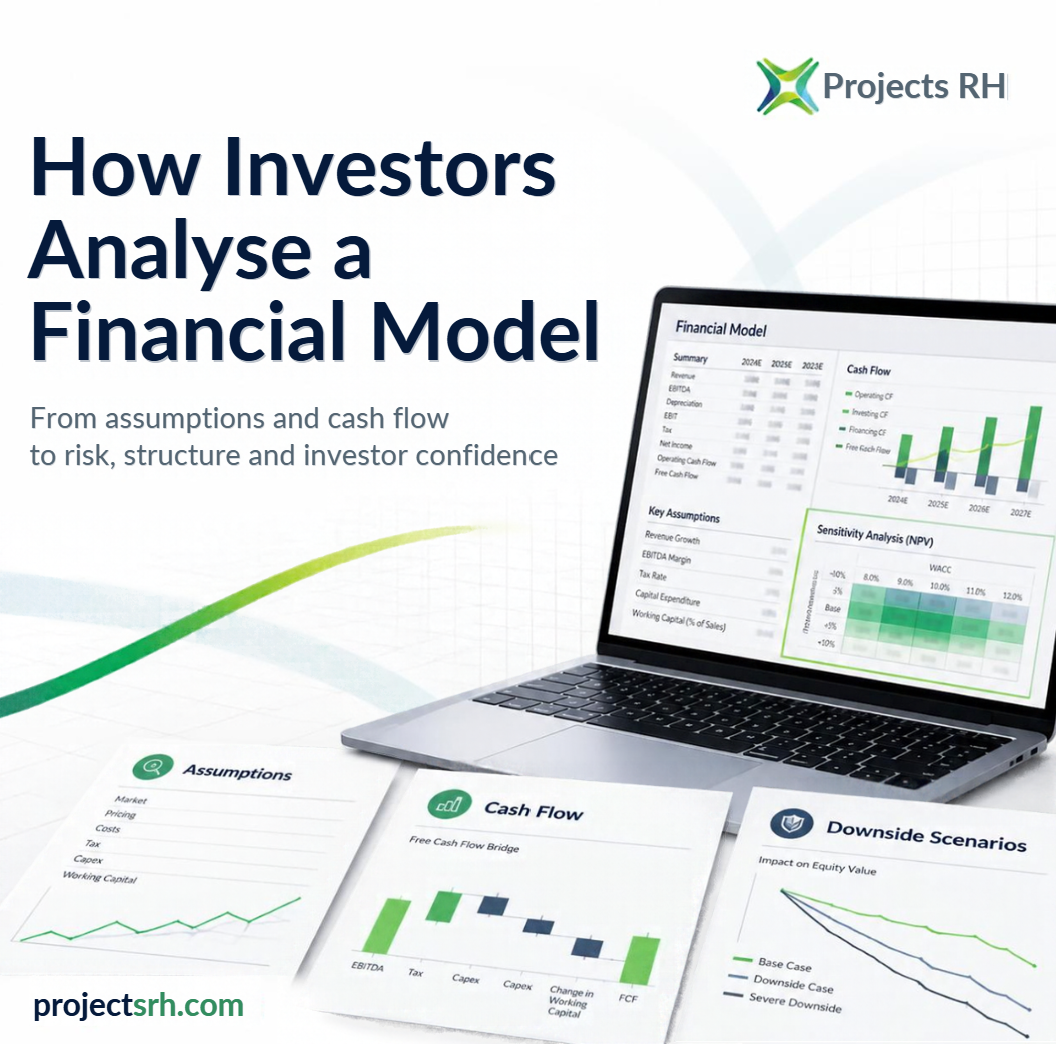
How Investors Analyse a Financial Model, and What They Test
Investors test assumptions, cash flow, mechanics and capital structure before returns. What they look for in a financial model, and what an investor-ready model must show.
Understanding Project Finance for Capital-Intensive Projects
Project finance is one way to fund a capital-intensive project. Here is how it differs from capital raising and M&A, and why each pathway sits under its own mandate.