
Mining Offtake Agreements: How They Support Finance
Mining offtake agreements can strengthen project finance through committed volumes, pricing protection, prepayments and creditworthy buyers.
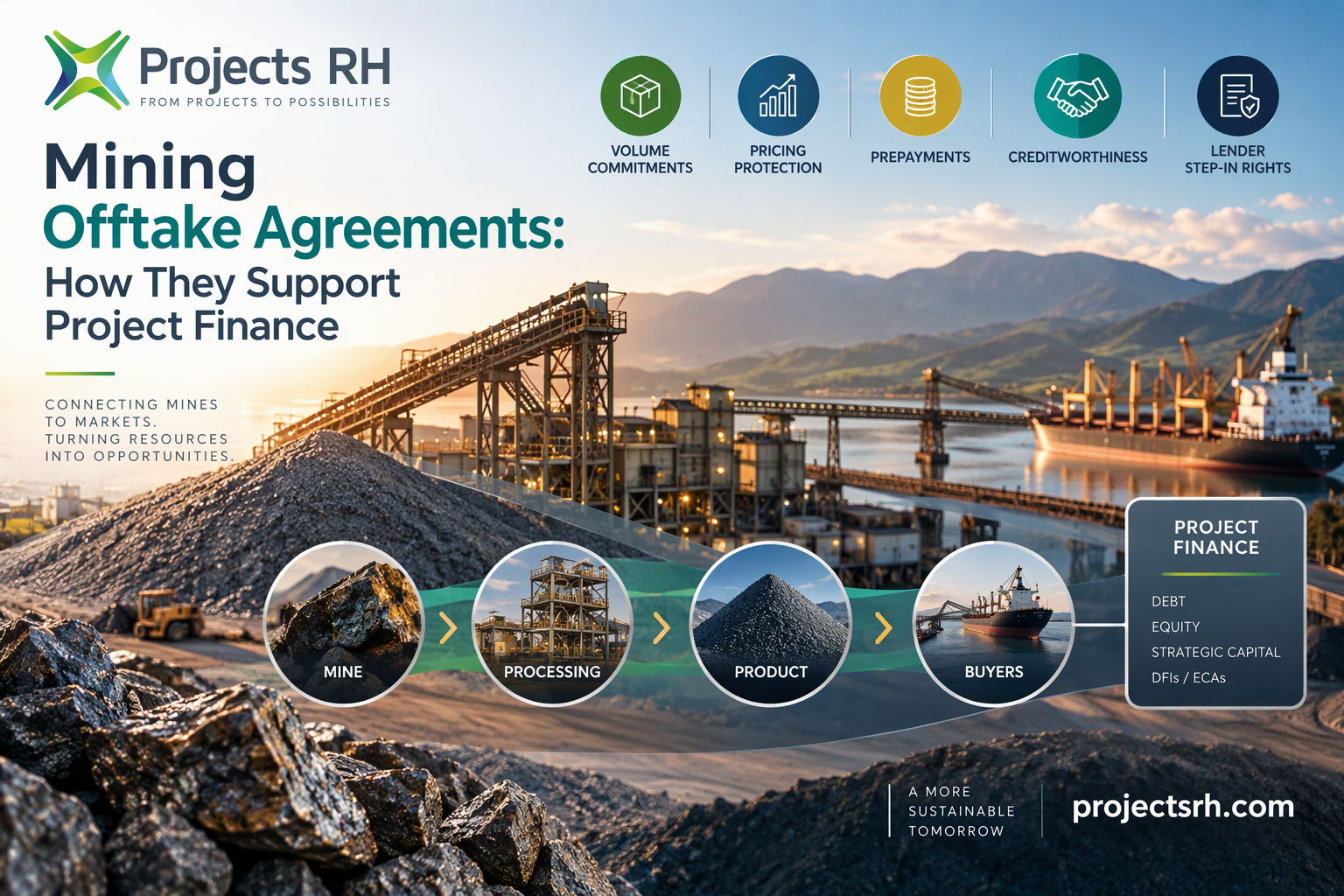
Mining Offtake Agreements can be far more than contracts to sell future production. Properly structured, they can become an important part of the financing architecture of a mining project.
In my experience, sponsors sometimes look at offtake too narrowly. They see it as a commercial document to be negotiated once the mine is approaching production.
A lender looks at it differently.
The lender wants to understand whether future production has a credible buyer, whether that buyer is financially capable of performing, how much volume is actually committed, how the product will be priced, what happens when prices fall, and whether the agreement survives the circumstances that could threaten debt repayment.
That difference is fundamental.
A signed offtake agreement is useful.
A bankable Mining Offtake Agreement is something considerably more valuable.
An offtake does not create bankability by itself. Its financing value depends on the quality of the buyer, the strength of the contractual commitments and the cash-flow protection it provides.
What Are Mining Offtake Agreements?
Mining Offtake Agreements are contracts under which a buyer commits to purchase an agreed quantity or proportion of future mineral production from a mine or processing project under defined commercial terms.
Those terms may include:
- Product specifications
- Contract duration
- Committed volumes
- Pricing formulas
- Floor or ceiling prices
- Delivery points
- Payment terms
- Quality adjustments
- Treatment and refining charges
- Conditions precedent
- Force majeure
- Termination rights
- Credit support
- Assignment provisions
- Lender protections
For project sponsors, the fundamental commercial objective is to establish a credible market for future production.
For project-finance lenders, the question goes further:
Does the agreement create a sufficiently predictable revenue stream to support debt?
That is the bankability test.
How Mining Offtake Agreements Support Project Finance
Project finance depends heavily on future project cash flows.
Physical assets matter, but lenders ultimately need confidence that the project can generate enough cash to pay operating expenses, meet obligations and service debt.
A credible mining offtake can help establish:
- Who purchases production
- What product is purchased
- How much is purchased
- For how long
- How prices are calculated
- When payments occur
- What happens if the buyer fails to perform
- What happens if the project cannot deliver
- Whether contractual revenues can be assigned to lenders
That information feeds directly into the project's financial model.
It can influence:
- Revenue assumptions
- Downside sensitivities
- Debt sizing
- DSCR calculations
- Working-capital requirements
- Reserve accounts
- Financing tenor
- Security arrangements
The stronger the contractual revenue case, the easier it can become for lenders to understand the project's ability to service debt.
That does not mean more contracted volume automatically creates more debt capacity.
Contract quality matters at least as much as contracted volume.
Why Offtake Matters More Before Financial Close
An offtake agreement signed after a project is already operating can provide commercial value.
For a development-stage mine, however, the agreement can have another purpose: it can become part of the evidence used to obtain construction capital.
This creates an important relationship:
Resource → Technical feasibility → Product → Buyer → Offtake → Revenue → Project finance
If one of those links is weak, financiers will investigate why.
A lithium developer, for example, may have a strong resource but still need to prove that its processing route can consistently produce a specification acceptable to the proposed buyer.
A copper developer may have excellent geology but still need to demonstrate that concentrate specifications, treatment charges, penalties, logistics and smelter relationships are commercially robust.
An offtake therefore sits at the intersection of the technical and commercial case.
Not Every Mining Offtake Agreement Is Bankable
This is one of the most important distinctions for sponsors.
An agreement saying:
"Buyer intends to purchase future production"
may demonstrate interest.
It does not necessarily provide lenders with dependable contracted revenue.
I would expect financiers to examine at least:
- The legal commitment
- Buyer creditworthiness
- Volume obligations
- Pricing
- Product specifications
- Contract duration
- Payment terms
- Termination rights
- Force majeure
- Conditions precedent
- Assignment and security
- Lender protections
A non-binding memorandum of understanding can be commercially useful.
It should not be confused with a binding long-term offtake.
Even a binding agreement can contain enough flexibility, conditions or termination rights to substantially reduce its financing value.
1. Volume Commitments: How Much Production Is Really Contracted?
The headline statement that "80% of production is under offtake" tells me very little by itself.
I would want to understand what "80%" actually means.
Is the buyer obligated to take 80%?
Can the buyer reduce volumes?
Is there a minimum annual quantity?
Does the obligation begin immediately at commissioning?
Are volumes linked to actual production?
Is there a tolerance band?
Can shortfalls be carried forward?
Is the arrangement take-or-pay, take-and-pay or simply an agreed marketing arrangement?
Those distinctions can materially change how lenders model revenue.
Take-or-Pay
Under a strong take-or-pay structure, the buyer has an obligation associated with a minimum contracted volume even if it does not physically take all of that volume, subject to the contractual terms.
That can create greater revenue certainty.
Take-and-Pay
Under a take-and-pay structure, payment is generally connected more closely to actual delivery and acceptance.
The project may consequently retain more volume or performance exposure.
Percentage of Production
Some contracts cover a percentage of actual production.
This can help align the commitment with mine performance, but lenders still need to understand minimum volumes, production shortfalls and how uncontracted product will be sold.
The important issue is not the label.
It is who carries volume risk.
2. Buyer Creditworthiness Can Determine the Value of the Offtake
Suppose two projects each have a ten-year offtake for 70% of production.
On paper, they look similar.
But Project A has an offtaker with a strong balance sheet, substantial liquidity and an established operating history.
Project B has an offtaker with limited capital and no meaningful credit support.
The agreements are not economically equivalent.
A contractual payment promise is only valuable if the counterparty has the capacity to perform it.
Lenders may therefore examine:
- Credit ratings, where available
- Audited accounts
- Balance-sheet strength
- Liquidity
- Existing debt
- Parent-company support
- Guarantees
- Letters of credit
- Security
- Operating history
- Industry position
- Concentration risk
This is why a strategically attractive buyer is not automatically a bankable buyer.
Strategic interest and creditworthiness are two different questions.
A sophisticated lender will test both.
3. Pricing Mechanisms Determine Who Carries Commodity Risk
Commodity prices move.
The question is not whether they will move.
The question is who carries the consequences when they do.
Mining Offtake Agreements can use several pricing approaches.
Market-Linked Pricing
Prices may be linked to recognised commodity benchmarks, potentially adjusted for:
- Quality
- Grade
- Payability
- Treatment charges
- Refining charges
- Transport
- Penalties
- Premiums
- Product specifications
This retains significant market exposure.
Fixed Pricing
A fixed price creates greater certainty but can transfer considerable market risk between buyer and seller.
A long-term fixed price that looks attractive today could become highly favourable to one party and highly unattractive to the other several years later.
Formula Pricing
Many agreements use formulas based on published benchmarks, adjustments or averaging periods.
From a financing perspective, transparency matters.
The financial model must be capable of matching the contractual formula.
Price Floors
A floor can be particularly valuable for debt analysis because it may provide downside protection.
If a project's economics require copper at USD X per tonne or lithium at USD Y per tonne to maintain acceptable coverage ratios, a contractual price floor may materially affect lender analysis.
But the floor is only as strong as:
- The entity guaranteeing it
- The volume to which it applies
- Its duration
- Conditions attached to it
- Termination provisions
A weak counterparty promising an excellent floor does not necessarily create strong credit.
4. Why Floor Prices Can Support Debt Capacity
Consider a simplified example.
Assume a project produces 100,000 units annually.
Its base-case model assumes a price of USD 100 per unit.
Annual gross revenue is therefore:
100,000 × USD 100 = USD 10 million
Now assume lenders stress the commodity price to USD 65.
Stress-case gross revenue falls to:
100,000 × USD 65 = USD 6.5 million
If the project's debt-service obligations require materially more cash than the stress case can generate, the financing structure may fail.
Now imagine a creditworthy buyer provides a contractual price floor of USD 80 covering 70% of production.
That does not eliminate commodity exposure.
But it can provide a more defensible downside revenue assumption on the contracted portion.
That can influence:
- Minimum revenue
- DSCR
- Debt sizing
- Reserve requirements
- Financing tenor
This is why lenders analyse the contract, not simply the commodity forecast.
5. Prepayments Can Turn Future Production Into Development Capital
One of the most commercially interesting features of mining offtake is the possibility of combining product sales with financing.
A buyer, trader, smelter or strategic customer may provide money upfront in exchange for future mineral deliveries.
That creates prepayment finance.
The capital may potentially support:
- Development
- Construction
- Equipment
- Working capital
- Expansion
- Refinancing
The advance is then economically recovered through future deliveries or deductions from sale proceeds, according to the structure.
This can be attractive to sponsors because it may reduce the immediate requirement for conventional equity.
But prepaid offtake should not be viewed as free money.
It creates obligations.
Sponsors need to understand:
- Repayment profile
- Delivery commitments
- Pricing discounts
- Security
- Interest or financing charges
- Exclusivity
- Tenor
- Volume
- Default consequences
- Interaction with senior debt
A prepayment that solves today's equity problem but heavily encumbers tomorrow's production can become expensive capital.
6. Prepayment Finance and Senior Debt Must Work Together
Suppose a mining development requires USD 300 million.
An illustrative financing structure could be:
| Capital Source | Illustrative Amount | |---|---:| | Sponsor equity | USD 60m | | Strategic investor | USD 40m | | Offtake prepayment | USD 50m | | Senior project debt | USD 150m | | Total | USD 300m |
The numbers are purely illustrative.
But the structure raises important questions.
If the offtaker receives security, how does that security rank relative to senior lenders?
Who controls project accounts?
Who receives production proceeds first?
Can the buyer terminate the offtake after a project-company default?
Can lenders assign the offtake?
Can a replacement project company continue delivering under the agreement?
What happens if the prepayment remains outstanding when senior debt is accelerated?
These are intercreditor questions.
They need to be resolved before financial close.
7. Product Specifications Are Financing Terms
Mining projects do not simply sell "copper", "lithium", "nickel" or "rare earths".
They sell products with specifications.
Those specifications can determine:
- Marketability
- Price
- Penalties
- Customer acceptance
- Processing requirements
- Revenue
- Working capital
For concentrates, issues might include:
- Grade
- Moisture
- Impurities
- Payability
- Deleterious elements
For battery materials:
- Purity
- Particle characteristics
- Chemical composition
- Customer qualification
For iron ore:
- Fe content
- Silica
- Alumina
- Phosphorus
The lender therefore needs confidence that the technical process can produce the product contemplated in the offtake agreement.
A project should not model premium revenue for a product it has not demonstrated it can consistently produce.
8. Delivery Terms Can Change Project Economics
An offtake price can look attractive until logistics are considered.
The agreement needs to specify the delivery point and who bears:
- Freight
- Insurance
- Storage
- Port charges
- Handling
- Customs
- Delay
- Demurrage
- Loss in transit
The project financial model should reflect those obligations consistently.
If the contract assumes delivered pricing but the financial model treats the price as if the buyer collects product at the mine gate, the revenue model may be overstated.
Inconsistencies between technical, commercial and financial assumptions are exactly the type of issue serious due diligence is designed to identify.
9. Contract Tenor Should Match the Financing Case
Contract duration matters.
A two-year offtake on a project seeking ten-year debt does not provide the same revenue visibility as a longer contract covering a substantial portion of the loan tenor.
That does not automatically make the shorter agreement unusable.
Commodities with deep, liquid markets may support merchant exposure beyond the contract term.
But lenders will need to understand:
- Remaining debt when the agreement expires
- Marketability after expiry
- Renewal assumptions
- Alternative buyers
- Commodity liquidity
- Product specification
- Price risk
The more specialised the product, the more important long-term contracted market access may become.
10. Termination Rights Can Destroy the Financing Value of an Offtake
A ten-year agreement is not truly ten years of dependable revenue if the buyer can easily terminate after year two.
Potential triggers may include:
- Failure to reach financial close
- Construction delays
- Missed long-stop dates
- Failure to meet product specifications
- Volume shortfalls
- Insolvency
- Permit failures
- Sanctions
- Change of control
- Force majeure
- Extended force majeure
- Material breach
The issue is not that termination rights should never exist.
They are necessary commercial protections.
The issue is whether the agreement can disappear at precisely the time lenders most need the revenue contract.
11. Lender Step-In Rights Protect Contract Continuity
This is one of the more technical but important elements of project finance.
If the project company defaults, lenders may need time to protect and restructure the project rather than immediately losing key contracts.
Step-in rights can allow lenders, their security agent or an appropriate replacement entity to intervene following specified defaults, subject to the direct agreement and underlying transaction documents.
These rights can permit lenders to:
- Receive notice of project-company default
- Benefit from cure periods
- Prevent immediate termination
- Cure certain defaults
- Exercise specified contractual rights
- Arrange for a replacement operator or owner
- Facilitate transfer or novation after enforcement
This is normally addressed through a direct agreement between the lender or security agent, project company and contractual counterparty.
The practical objective is straightforward.
If an offtake is fundamental to the project's value, lenders do not want that agreement disappearing immediately after a project-company default.
The contract therefore needs to work not only when everything goes according to plan.
It must also work when things go wrong.
12. Assignment Rights Matter to Lenders
In limited-recourse project finance, lenders typically take security over important project rights.
That can include rights under:
- Construction contracts
- Operating agreements
- Permits where legally assignable
- Insurance
- Accounts
- Offtake contracts
An offtake containing absolute prohibitions on assignment could create difficulties if it prevents an appropriate security structure.
The parties therefore need to address:
- Security assignments
- Lender consent rights
- Transfer following enforcement
- Replacement project companies
- Novation
- Buyer approval
This is legal structuring rather than merely commercial negotiation.
It should be addressed early.
13. Force Majeure Needs Careful Analysis
Force majeure provisions allocate risks outside the parties' normal control.
In mining, potential events might include:
- Natural disasters
- Infrastructure failures
- Government measures
- War
- Civil disturbance
- Port closure
- Export restrictions
- Certain supply-chain disruptions
But broad drafting can create financing uncertainty.
A lender will want to understand when a buyer may stop paying or accepting deliveries, how long relief lasts, and when termination becomes possible.
Sponsors should also examine whether force-majeure provisions across different project documents align.
Structural mismatches matter.
14. Conditions Precedent Can Delay the Commercial Value of the Agreement
Mining offtakes are frequently signed subject to conditions.
Those may include:
- Financing
- Permits
- Construction approvals
- Technical milestones
- Product qualification
- Corporate approvals
- Government approvals
- Minimum production capacity
A signed agreement with significant unsatisfied conditions is not equivalent to an unconditional agreement.
The financial model and investor materials should reflect that distinction honestly.
A conditional offtake should not be presented as unconditional revenue.
15. How Lenders Stress-Test Mining Offtake Agreements
A lender does not simply copy the offtake price and volume into the base-case model.
The lender is likely to test scenarios such as:
Price Stress
What happens when the benchmark price falls?
Does the project still meet debt-service requirements?
Volume Stress
What happens if the mine produces 85% rather than 100% of expected output?
Ramp-Up Stress
What if commercial production takes six additional months?
Quality Stress
What if product attracts penalties rather than premiums?
Buyer Default
What if the offtaker stops performing?
Can the product be sold elsewhere?
Logistics Stress
What happens when transport or port access is disrupted?
Termination Stress
What happens if the offtake terminates before debt matures?
The objective is to understand where debt repayment becomes vulnerable.
16. Government and Export-Credit Support Is Changing Offtake Finance
Offtake is increasingly becoming part of government-backed critical-minerals finance.
The U.S. Export-Import Bank's Supply Chain Resiliency Initiative supports eligible international critical-minerals projects connected with signed long-term offtake contracts with U.S. companies.
U.S. EXIM's support for critical minerals can also support eligible critical-minerals transactions.
UK Export Finance's Critical Minerals Supply Finance provides another example of government-backed financing being linked to strategically important mineral supply chains.
This can create an important financing chain:
Mine → Strategic buyer → Export market → Government-backed finance → Senior debt
For sponsors, that means offtake strategy can influence not only marketability but also the sources of capital potentially available to a project.
17. DFIs Still Look Beyond the Offtake
A strong buyer does not eliminate the rest of project due diligence.
The International Finance Corporation's Metals and Minerals practice illustrates the wider role institutional capital can play in metals and mining.
Institutional finance will still examine:
- Technical feasibility
- Resource and reserves
- Mine plan
- Metallurgy
- CapEx
- Opex
- Permitting
- ESG
- Community impacts
- Management
- Construction
- Governance
- Financial resilience
Offtake helps address market and revenue risk.
It does not solve every other project risk.
18. A Practical Test for a Bankable Mining Offtake Agreement
Before presenting an offtake to lenders, I would ask these questions.
Buyer
- Who is the buyer?
- Does the buyer have sufficient financial capacity?
- Is parent support available?
- Could credit enhancement be required?
Product
- What exactly is being sold?
- Has the project demonstrated that specification?
- What happens if quality varies?
Volume
- What is the minimum commitment?
- Is it take-or-pay?
- What happens during ramp-up?
- What happens after a production shortfall?
Price
- Fixed, floating or formula?
- Which benchmark?
- Is there a floor?
- Is there a ceiling?
- Are there discounts or premiums?
Term
- How long does the contract last?
- How does it compare with the proposed debt tenor?
Delivery
- Where does title pass?
- Who carries shipping risk?
- Who pays logistics costs?
Termination
- What allows each party to terminate?
- What notice applies?
- Are lenders protected?
Security
- Can contract rights be assigned?
- Can lenders take security?
- Is a direct agreement contemplated?
Step-In
- Will lenders receive notices?
- Are cure periods available?
- Can lenders exercise the agreed step-in protections?
Prepayment
- Is capital provided upfront?
- How is it amortised?
- What security does the offtaker receive?
- How does it rank with senior debt?
If those answers are unclear, the agreement may not yet be lender-ready.
Mining Offtake Agreements: Commercial Value vs Financing Value
| Feature | Commercial Value | Project Finance Value | |---|---|---| | Identified buyer | Confirms market interest | Supports revenue credibility | | Volume commitment | Provides sales visibility | Supports volume assumptions | | Long tenor | Secures customer relationship | Can support debt tenor | | Price formula | Defines commercial revenue | Allows lender modelling | | Price floor | Protects downside | May strengthen stressed debt coverage | | Creditworthy buyer | Reduces payment risk | Strengthens contracted revenue | | Prepayment | Provides upfront liquidity | Can form part of capital stack | | Assignment | Limited normal-course value | Important for lender security | | Direct agreement | Usually lender-driven | Protects contractual continuity | | Step-in rights | Limited normal-course value | Important protection after default |
An agreement can be commercially attractive without being particularly valuable to project lenders.
The strongest structures achieve both.
Common Mistakes Sponsors Make With Mining Offtake Agreements
Signing Too Early
A sponsor may lock away production before understanding the project's future strategic value.
Contracting Too Much Production
Financing security can come at the cost of future commercial flexibility.
Giving Away Pricing Upside
An aggressive discount or fixed-price mechanism can make capital extremely expensive over the life of the project.
Choosing a Weak Counterparty
A long contract with a weak buyer can provide very little lender comfort.
Ignoring Assignment
Sponsors may negotiate commercial terms without considering future lender-security requirements.
Overlooking Termination Rights
A contract that is easy to terminate may have little financing value.
Treating a Prepayment Like Equity
It is not.
The project still has delivery and financial obligations.
Failing to Align Technical and Commercial Assumptions
The mine plan, processing assumptions, product specifications and delivery commitments need to tell the same story.
Offtake, Streaming and Royalties Are Not the Same
These structures can all provide capital or commercial support, but they allocate economics differently.
Offtake
The buyer purchases specified future production under agreed commercial terms.
Prepaid Offtake
The buyer provides capital upfront against future contracted deliveries or sale proceeds.
Streaming
A financier typically provides upfront capital in exchange for rights to purchase a defined portion of future production under specified economic terms.
Royalty
A financier provides capital in exchange for an economic interest linked to future revenue or production without necessarily purchasing the physical product.
Each structure affects:
- Cash flow
- Future upside
- Security
- Flexibility
- Debt capacity
- Investor returns
Sponsors should compare the lifetime economic cost rather than simply the upfront cash available.
When Should a Mining Project Negotiate Offtake?
There is no universal moment.
But I would generally want the project to understand its:
- Resource
- Process route
- Product
- Expected specification
- Production profile
- Target market
- Cost position
- CapEx
- Development schedule
- Financing strategy
before committing the majority of future production for a long period.
Negotiating too early can sacrifice value.
Negotiating too late may delay financing.
The offtake strategy therefore needs to develop alongside project preparation, not independently from it.
Investor Readiness Before Offtake-Backed Finance
Before approaching lenders with an offtake-backed financing proposition, the project needs more than the sales contract.
I would want to see:
- Credible technical studies
- Resource and reserve support
- Mine plan
- Process design
- Realistic CapEx
- Realistic Opex
- Financial model
- Offtake terms
- Buyer-credit analysis
- Permitting status
- ESG work
- Construction strategy
- Security structure
- Risk allocation
A structured [Investment Readiness Assessment](Investment Readiness Assessment ``) can help identify material gaps before a project presents its financing case to institutional capital.
The objective is not to convince lenders that the offtake removes risk.
The objective is to demonstrate exactly which risks the agreement mitigates and which risks remain.
Frequently Asked Questions About Mining Offtake Agreements
What are Mining Offtake Agreements?
Mining Offtake Agreements are contracts under which buyers commit to purchase agreed quantities or proportions of future mineral production under defined commercial terms.
They can provide revenue visibility and, when sufficiently strong, support project-finance analysis.
Can an offtake agreement help finance a mine?
Yes.
A credible long-term offtake can support financing by providing evidence of future demand, contracted volumes, pricing mechanisms and buyer commitments.
However, lenders still need to assess project economics, technical feasibility, buyer credit and contractual risk.
What makes a mining offtake agreement bankable?
A bankable agreement generally requires clearly defined product specifications, meaningful volume commitments, transparent pricing, an appropriate tenor, a sufficiently creditworthy buyer and contractual provisions compatible with the financing structure.
What is a mining prepayment?
A mining prepayment is financing provided upfront against future mineral deliveries or sale proceeds.
The facility can provide development or working capital but normally creates repayment, delivery and security obligations.
Why does buyer creditworthiness matter?
A long-term payment obligation is only as reliable as the party making it.
Lenders therefore assess whether the offtaker has sufficient financial capacity to honour the contract, particularly during adverse market conditions.
How do price floors support project finance?
Price floors can reduce downside revenue exposure on contracted volumes.
If a floor is enforceable and supported by a creditworthy counterparty, lenders may be able to incorporate that protection into stressed financial analysis.
What are lender step-in rights?
Step-in rights are contractual protections that can allow lenders, subject to the relevant direct agreement and applicable law, to intervene after specified project-company defaults, benefit from cure periods or facilitate replacement arrangements before an important project contract is terminated.
Why do lenders require direct agreements?
Direct agreements create contractual rights between lenders and important project counterparties.
They can address default notices, cure periods, security assignments, step-in protections and transfer or novation arrangements.
Can a mining offtake be assigned to lenders?
Potentially, but this depends on the contract and applicable law.
Project-finance transactions may require provisions allowing security assignments and transfers following enforcement, often supported by a direct agreement with the buyer.
Should a project contract 100% of future production?
Not necessarily.
Contracting a large proportion can strengthen revenue visibility but may reduce future commercial flexibility and commodity-price upside.
The appropriate percentage depends on the financing requirement, marketability of the product, project risk and sponsor strategy.
Sources
- IFC: Metals and Minerals
- U.S. EXIM: Supply Chain Resiliency Initiative
- U.S. EXIM: Support for Critical Minerals Transactions
- UK Export Finance: Critical Minerals Supply Finance
- Herbert Smith Freehills Kramer: Critical Mineral Offtake Agreements
- Skadden: Lenders' Relationships With Project Counterparties
- International Mining and Resources Conference: Offtake Agreements and Critical Minerals Investment
Final Perspective: An Offtake Is Only as Strong as the Risk It Actually Removes
The financing value of a Mining Offtake Agreement does not come from having a signed contract in the data room.
It comes from what that contract actually does.
Does it commit meaningful volumes?
Is the buyer creditworthy?
Can the project produce the specification promised?
Does the pricing formula survive a down-cycle?
Is there meaningful downside protection?
Can the contract support debt for an appropriate period?
Does a prepayment strengthen the capital stack without creating unmanageable obligations?
Can lenders protect the agreement if the project company defaults?
Those are the questions that turn offtake from a sales document into part of the project-finance architecture.
I would therefore encourage sponsors to negotiate Mining Offtake Agreements with the financing strategy already in mind.
The objective is not simply to prove that someone wants the mineral. The objective is to demonstrate that the commercial arrangement creates cash flow that institutional capital can understand, stress and rely upon.
If you are preparing a mining project for capital raising or offtake-backed finance, the practical next step is to identify the commercial, technical and financing gaps that lenders and strategic buyers are likely to challenge before formal outreach begins. /intake.html.

What to do next
Projects RH prepares the company and the project first, then takes them to investors. The fastest way to find out where you stand is a short call.
Keep reading
JORC vs NI 43-101: What Mining Investors Need to Know
JORC and NI 43-101 share resource categories but differ in legal status, expert responsibility, technical reporting and cross-border filing requirements.

Mining Royalties vs Streaming: Choosing Capital
Mining royalties, streaming and equity transfer value differently. Compare dilution, cash flow, control, commodity upside and long-term project economics. `
Lithium vs Copper Project Finance: Investor Requirements
Lithium and copper projects face different financing tests. Compare pricing, offtake, processing, CapEx, risk and development timelines.