
Mining Project Bankability: Why Great Resources Still Fail
A world-class resource is not automatically financeable. Discover how metallurgy, recovery, infrastructure, permits, CapEx and offtake shape mining bankability.
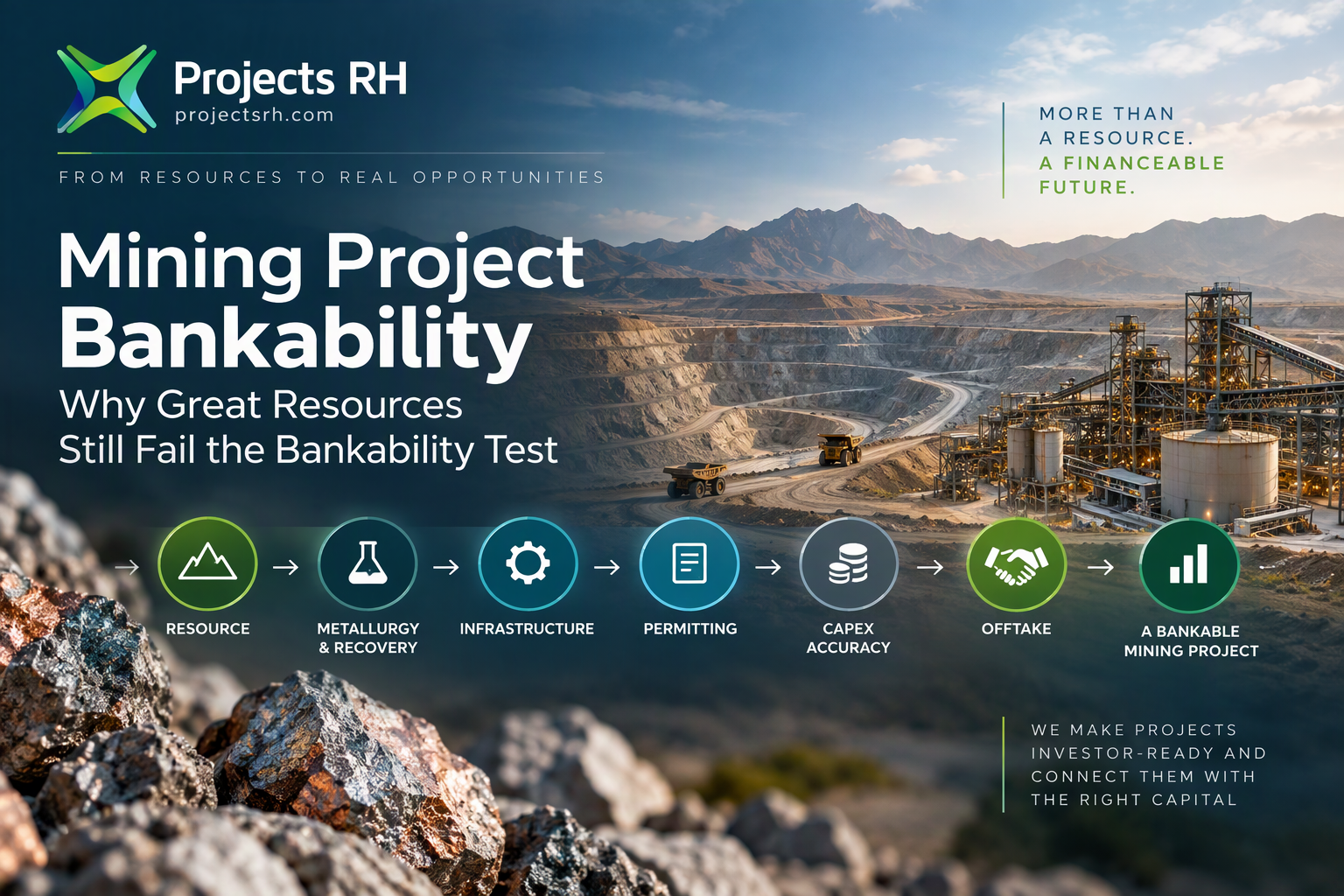
Mining Project Bankability begins with a distinction that the mining industry sometimes learns the hard way:
A world-class mineral resource is not automatically a world-class investment.
A deposit can be large.
Grades can be attractive.
Exploration results can be exceptional.
The geological story can be compelling.
And the project can still struggle to attract institutional capital.
Why?
Because investors and lenders are not financing tonnes in the ground.
They are financing the ability to convert a mineral resource into saleable product, predictable cash flow and an acceptable return within a manageable risk framework.
Throughout my career in finance, resources and project development, I have seen the same tension repeatedly. Sponsors naturally lead with geology because geology creates the opportunity.
Capital providers go several steps further.
They want to understand metallurgy, recovery, mine design, processing, infrastructure, permits, CapEx, OpEx, product specifications, logistics, offtake, execution risk and the resilience of the financial model.
That is the real question behind Mining Project Bankability.
What Is Mining Project Bankability?
Mining Project Bankability is the degree to which a mining project has sufficient technical, commercial, financial, regulatory and execution evidence for investors and lenders to commit capital on acceptable terms.
Bankability is therefore not another word for resource size.
It is the point where multiple parts of a mining project begin to work together convincingly:
Resource → Metallurgy → Recovery → Mine Plan → Processing → Infrastructure → Permits → CapEx → OpEx → Product → Offtake → Cash Flow → Financing
A weakness anywhere in that chain can affect the economics of everything downstream.
A technically impressive mineral resource can therefore remain difficult to finance if investors cannot establish a credible path from the resource to cash flow.
A Mineral Resource Is the Beginning, Not the Investment Case
The mining industry rightly places enormous importance on geological confidence.
Under the JORC Code, Mineral Resources and Ore Reserves are classified according to levels of geological confidence together with technical and economic considerations.
Canadian NI 43-101 similarly establishes standards governing disclosure of mineral projects and technical reporting.
These frameworks matter enormously.
They help investors understand what geological information has been established, how it was prepared and the level of confidence attached to it.
But lenders ultimately need another layer of evidence.
They need to establish whether that mineral inventory can support a mine that can actually:
- be built;
- operate safely;
- recover the expected mineral;
- produce a saleable product;
- access power and water;
- reach its market;
- obtain and maintain permits;
- operate within realistic costs; and
- generate sufficient cash to support the proposed financing.
Geology defines the opportunity. Bankability tests whether the opportunity can become an economic operation.
Metallurgy: Where a Great Resource Can Become a Difficult Project
One of the most important bankability questions is simple:
Can the valuable mineral actually be recovered economically?
A resource estimate may establish the presence, quantity and grade of mineralisation.
That does not automatically establish an economic processing route.
Metallurgical testwork can examine:
- mineralogy;
- liberation;
- hardness;
- grindability;
- comminution;
- flotation;
- leaching;
- recovery;
- concentrate quality;
- impurities;
- reagent consumption;
- water requirements;
- variability; and
- processing response across different ore types.
This is where apparently attractive geology can encounter economic reality.
An orebody with strong headline grade can become considerably less attractive if it requires:
- complex processing;
- expensive reagents;
- unusually fine grinding;
- high energy consumption;
- multiple processing stages;
- difficult impurity removal; or
- expensive downstream treatment.
For lenders, metallurgy is therefore not simply a technical appendix.
It directly influences:
Recovery → Production → Revenue → OpEx → CapEx → CFADS → Debt Capacity
Recovery Is a Financial Variable
Consider a simplified example.
A financial model assumes:
Annual contained metal: 100,000 units
Metallurgical recovery: 90%
Saleable recovered production is therefore approximately:
90,000 units
Now suppose subsequent testwork indicates sustainable recovery is closer to:
82%
Recovered production becomes:
82,000 units
That is nearly 9% lower than the original recovered volume before considering any additional processing costs.
If the project's debt capacity was calculated using the original production case, the financing assumptions may now be overstated.
The lesson is straightforward:
Metallurgical recovery is not simply a laboratory result. It is one of the assumptions connecting geology to revenue.
This is why lenders and technical advisers care about whether recovery assumptions are adequately supported by representative testwork.
Metallurgical Variability Matters
Average recovery can also hide significant risk.
An orebody may contain:
- different lithologies;
- oxide material;
- transitional material;
- sulphide material;
- variable hardness;
- different mineral associations; or
- changing impurity levels.
A single metallurgical sample cannot automatically represent an entire mine plan.
If recovery falls materially in particular zones or years, cash flow can behave differently from the headline feasibility case.
That is why bankability depends not only on:
“What recovery did the test achieve?”
but also:
“How representative is that recovery of the material the mine will actually process through time?”
Mine Plan and Production Schedule
A bankable mine needs more than an economic resource.
It needs an executable production plan.
Capital providers may examine:
- mining method;
- production rate;
- dilution;
- ore loss;
- stripping requirements;
- mine sequencing;
- geotechnical conditions;
- equipment fleet;
- waste movement;
- stockpiles;
- ramp-up;
- sustaining capital; and
- mine life.
Timing matters.
A project can contain substantial high-grade material but still face weak early cash flow if access requires major pre-stripping or underground development.
That matters because debt service occurs according to a schedule.
The mine plan and the financing schedule therefore need to speak to each other.
Processing Plant Bankability
Processing plants can represent a substantial part of mine development CapEx.
Investors need confidence in:
- process selection;
- design criteria;
- throughput;
- recovery assumptions;
- equipment;
- availability;
- ramp-up;
- maintenance;
- consumables;
- energy;
- water;
- tailings;
- product specifications; and
- operating costs.
Novel processing technology can offer significant upside.
It can also introduce scale-up risk.
A process demonstrated in a laboratory is not automatically equivalent to a commercial plant operating continuously at design throughput.
For lenders, technology maturity is therefore part of the risk equation.
Infrastructure Can Decide Whether the Deposit Is Economic
Some of the world's most exciting mineral deposits are located far from existing infrastructure.
That is often where bankability becomes difficult.
A mine may require:
- grid connection;
- dedicated generation;
- transmission lines;
- roads;
- rail;
- port access;
- water supply;
- pipelines;
- accommodation;
- communications;
- fuel storage; and
- logistics facilities.
These are not peripheral costs.
They can materially alter:
- development CapEx;
- construction schedule;
- operating cost;
- permitting;
- financing requirements; and
- execution risk.
A deposit can therefore be exceptional in geological terms and expensive in infrastructure terms.
The relevant investment question is not simply where the mineral is. It is what it costs to turn that location into an operating supply chain.
Power Is Becoming a Strategic Mining Variable
Reliable energy affects almost every major process:
- crushing;
- grinding;
- pumping;
- ventilation;
- processing;
- dewatering;
- materials handling; and
- site infrastructure.
Projects in remote jurisdictions may need:
- transmission infrastructure;
- onsite generation;
- renewable generation;
- battery storage;
- thermal generation; or
- hybrid systems.
Energy therefore influences both CapEx and OpEx.
For processing-intensive minerals, energy availability and pricing can materially shape project economics.
It can also affect the project's emissions profile and environmental strategy.
Water Can Become a Bankability Constraint
Mines and processing facilities can require significant water infrastructure.
Projects may need to establish:
- availability;
- legal rights;
- extraction permits;
- competing demand;
- treatment;
- recycling;
- pumping;
- storage; and
- discharge arrangements.
A financial model cannot merely assume that the required water appears at the plant.
The physical, legal and economic pathway needs to be understood.
In water-constrained jurisdictions, this can become a major investment issue.
Permitting Risk Is Schedule Risk
A project may demonstrate attractive economics and still lack the legal ability to begin construction.
Relevant approvals can include:
- mining licences;
- environmental approvals;
- construction permits;
- water rights;
- land access;
- tailings approvals;
- heritage approvals;
- explosives permits;
- grid approvals;
- operating licences; and
- other jurisdiction-specific authorisations.
The critical question is not merely:
“Can the permit eventually be obtained?”
It is:
“Can the permit be obtained within the timetable on which the financing and construction plan depend?”
A twelve-month permitting delay can affect:
- construction;
- procurement;
- contractor availability;
- inflation;
- financing costs;
- interest during construction; and
- first production.
That means permitting assumptions belong inside the critical path and financial model.
Environmental and Social Risk Is Financial Risk
Mining projects can have material environmental and social impacts.
Institutional investors may examine:
- biodiversity;
- tailings;
- waste;
- water;
- land acquisition;
- community impacts;
- worker safety;
- Indigenous Peoples;
- resettlement;
- closure;
- rehabilitation;
- climate; and
- stakeholder engagement.
IFC's Environmental and Social Review Procedures integrate environmental and social risk management into project appraisal and supervision.
IFC's process can include Environmental and Social Action Plans, project commitments and conditions that need to be satisfied during the investment process.
The conclusion for sponsors is important:
Environmental and social requirements are not separate from financing. They can influence whether financing proceeds, what conditions attach to it and how the project is monitored.
CapEx Accuracy: One of the Hardest Bankability Tests
Mining projects are highly sensitive to capital cost.
A feasibility study may appear robust at:
Initial CapEx: $500 million
Suppose tendering and detailed engineering later indicate:
Initial CapEx: $625 million
That is a 25% increase.
The impact can extend far beyond the extra $125 million.
Additional CapEx may require:
- more sponsor equity;
- more debt;
- revised debt sizing;
- lower equity IRR;
- additional contingency;
- different financing instruments; or
- complete restructuring of the transaction.
The economics may still work.
But the project that investors originally evaluated is no longer the same project.
Why CapEx Estimates Move
Capital estimates can change because of:
- incomplete engineering;
- scope definition;
- commodity-price inflation;
- labour;
- logistics;
- equipment pricing;
- exchange rates;
- infrastructure omissions;
- owner costs;
- contingency;
- escalation;
- permitting requirements;
- schedule changes; or
- underestimated indirect costs.
This is why lenders care about the maturity and basis of the estimate, not only the headline number.
A precise-looking spreadsheet cannot compensate for immature engineering.
Contingency Is Not Spare Money
Developers sometimes view contingency as a number added to satisfy financiers.
That misses the purpose.
Contingency exists because cost estimates contain uncertainty.
The appropriate contingency depends on:
- engineering maturity;
- estimate methodology;
- procurement status;
- project complexity;
- location;
- technology;
- construction strategy; and
- risk profile.
If contingency is insufficient, eventual overruns can return directly to sponsors.
If contingency is excessive, the financing requirement can become unnecessarily large.
A bankable estimate therefore needs both realism and discipline.
OpEx Accuracy Matters Just as Much
A mine may operate for decades.
A small recurring error in operating costs can therefore have an enormous cumulative impact.
Important variables can include:
- power;
- labour;
- reagents;
- fuel;
- explosives;
- maintenance;
- grinding media;
- water;
- transport;
- treatment charges;
- royalties;
- waste handling; and
- sustaining CapEx.
The financial model should show how these assumptions behave under downside cases.
Bankability is rarely destroyed by one spreadsheet cell. It is weakened when multiple optimistic assumptions compound.
Product Quality Can Change the Economics
Producing concentrate is not the same as producing bankable revenue.
Investors need to know what the project will actually sell.
Relevant characteristics may include:
- grade;
- impurities;
- moisture;
- particle size;
- payability;
- penalties;
- treatment charges;
- refining charges;
- transport requirements; and
- customer specifications.
A project may achieve strong recovery but produce a concentrate containing impurities that reduce marketability or trigger penalties.
That can materially alter realised revenue.
Product specifications therefore belong inside both technical analysis and commercial due diligence.
Offtake: Can the Product Actually Be Sold?
One of the most important commercial bankability questions is:
Who will buy the product, on what terms, for how long and with what credit quality?
An offtake agreement can potentially address:
- product;
- volumes;
- tenor;
- pricing mechanism;
- benchmark;
- treatment charges;
- penalties;
- payment terms;
- delivery;
- quality;
- termination;
- force majeure;
- credit support; and
- prepayment.
But an offtake agreement is not automatically bankable.
Lenders need to understand the counterparty.
A five-year agreement with a weak counterparty may provide less comfort than a properly structured agreement with a financially strong buyer.
Offtake therefore transforms some market risk into counterparty risk.
Commodity Price Assumptions
Mining projects are highly exposed to commodity prices.
The financial model may contain:
- spot price;
- consensus price;
- long-term price;
- lender case;
- downside case; and
- severe downside case.
Sponsors naturally see upside.
Debt providers focus on repayment under less favourable scenarios.
Suppose a project has excellent economics at:
Copper: $5.00/lb
but struggles to cover debt service at:
Copper: $3.50/lb
The lender will want to understand that sensitivity.
A mining project should not require an exceptionally favourable commodity environment merely to remain solvent.
Exchange Rates Can Change the Mining Economics
Many mining projects earn revenue in US dollars while incurring a meaningful proportion of costs in local currency.
This creates exposure to exchange rates.
Currency movements can affect:
- CapEx;
- OpEx;
- debt service;
- taxes;
- royalties;
- equipment imports; and
- shareholder returns.
The financial model therefore needs internally consistent currency assumptions.
A superficially attractive project can become materially different when FX assumptions change.
Logistics Are Part of the Product
The mine does not create economic value simply by producing material at the gate.
The product may need to move through:
Mine → Road/Rail → Port → Storage → Shipping → Processor/Customer
Each step introduces:
- cost;
- capacity constraints;
- schedule;
- counterparty risk;
- infrastructure dependency; and
- potential disruption.
For bulk commodities, transport can become a major part of the economics.
For critical minerals, downstream processing availability may be equally important.
The project finance case therefore extends beyond the mine fence.
Tailings, Waste and Closure Matter to Capital
A bankable mine must also consider what happens to waste and what happens at the end of the asset's life.
Capital providers may examine:
- tailings design;
- waste storage;
- water management;
- closure plan;
- rehabilitation;
- financial assurance;
- long-term monitoring; and
- associated costs.
Underestimating closure liabilities can overstate project value.
The financial model should therefore reflect credible lifecycle obligations rather than treating closure as a distant issue with no present economic consequence.
The Difference Between Resource, Reserve and Bankable Project
These concepts should not be confused.
Mineral Resource
Evidence indicates mineralisation with defined geological confidence and relevant prospects for economic extraction under the applicable reporting framework.
Mineral Reserve
A mineable part of a resource supported by relevant technical and economic assessments and modifying factors under the applicable reporting code.
Bankable Mining Project
A project whose integrated technical, commercial, financial, regulatory and execution evidence is sufficiently developed for capital providers to assess financing.
A resource answers “what is there?” A reserve addresses “what can be mined economically under the applicable assumptions?” Bankability asks “can this project actually be financed and executed?”
These are related questions.
They are not the same question.
JORC, NI 43-101 and Bankability
The JORC Code provides minimum standards for public reporting of Exploration Results, Mineral Resources and Ore Reserves and is designed to inform investors and their advisers.
Canada's NI 43-101 framework establishes standards for mineral-project disclosure, including technical reports and Qualified Person requirements.
These frameworks are essential to mining investment analysis.
But compliance with a reporting code should not be interpreted as a financing commitment.
Bankability requires capital providers to assess how the entire development case works together.
The Mining Project Bankability Chain
I think of mining bankability as a chain:
Geology
↓
Metallurgy
↓
Mine Plan
↓
Processing
↓
Infrastructure
↓
Permits
↓
CapEx + OpEx
↓
Product Specification
↓
Logistics
↓
Offtake
↓
Financial Model
↓
Risk Allocation
↓
Debt + Equity Capacity
A project is only as financeable as the critical weaknesses inside that chain.
How Lenders Stress-Test a Mining Project
A lender rarely evaluates only management's base case.
The model may be tested for:
- commodity-price downside;
- lower recovery;
- lower throughput;
- higher CapEx;
- construction delay;
- higher OpEx;
- slower ramp-up;
- adverse FX;
- higher interest rates;
- weaker product payability; or
- combinations of several adverse assumptions.
This is where apparently strong projects sometimes fail.
A project that works only when every assumption is achieved perfectly is not a resilient financing proposition.
Bankability begins where the base case stops being the only case that works.
Why World-Class Resources Still Fail the Bankability Test
In my experience, the reasons usually fall into one or more of seven categories.
1. Metallurgy Is Not Mature Enough
Recovery or process design remains uncertain.
2. Infrastructure Is Underestimated
Power, water, roads, rail or port requirements materially increase the development cost.
3. Permits Do Not Match the Schedule
The financing assumes construction can begin before key approvals are realistically available.
4. CapEx Is Too Optimistic
Engineering maturity does not justify the precision of the estimate.
5. Operating Assumptions Are Too Aggressive
Recovery, throughput, grades or costs leave insufficient downside headroom.
6. The Product Has No Robust Commercial Path
Offtake, product quality, logistics or downstream processing remain uncertain.
7. The Financial Model Is Built Around the Desired Return
Instead of testing whether project economics can support a realistic financing structure, assumptions are adjusted until the model produces the target valuation.
That is not bankability.
The Projects RH Mining Project Bankability Test
Before approaching institutional capital for a mining project, I would ask:
- Is the resource supported by appropriate technical reporting?
- Is metallurgical testwork representative of the planned ore feed?
- Are recovery assumptions defensible?
- Is the mine plan executable?
- Is the processing route proven at the required scale?
- Are power, water and logistics realistically available?
- Does the permitting timetable support the construction schedule?
- Is the CapEx estimate appropriate to the engineering maturity?
- Does contingency reflect actual project uncertainty?
- Are OpEx and sustaining CapEx credible?
- Is the product commercially acceptable to real customers?
- Is there a credible offtake strategy?
- Does the financial model survive lower prices, lower recovery and higher costs?
- Are environmental and social risks being actively managed?
- Can the project's debt and equity structure absorb the residual risks?
If several answers remain uncertain, the project may have an excellent mineral resource but still require material work before becoming bankable.
Frequently Asked Questions About Mining Project Bankability
What is Mining Project Bankability?
Mining Project Bankability is the degree to which a mining project has sufficient technical, commercial, financial, regulatory and execution evidence for investors and lenders to commit capital on acceptable terms.
Does a large mineral resource make a mining project bankable?
No.
A large or high-grade resource can create substantial potential value, but bankability also depends on metallurgy, recovery, processing, infrastructure, permits, costs, marketability, offtake, execution and project economics.
Why is metallurgy important to mining finance?
Metallurgy determines how effectively valuable minerals can be recovered and transformed into a saleable product.
Recovery, process complexity, impurities, reagent use and energy consumption can materially affect revenue, CapEx and OpEx.
Why does metallurgical recovery affect bankability?
Lower recovery generally means less saleable production from the same amount of contained mineral.
That can reduce revenue, cash flow and debt capacity.
Does a JORC Resource guarantee financing?
No.
The JORC Code provides standards for public reporting of Exploration Results, Mineral Resources and Ore Reserves. Financing remains a separate investment and credit decision.
Does an NI 43-101 technical report make a project bankable?
Not automatically.
NI 43-101 establishes disclosure and technical-reporting requirements for applicable Canadian mineral-project disclosures. Investors and lenders still need to assess the complete project economics, risks and financing case.
Why is CapEx accuracy important?
Initial CapEx determines a major part of the capital requirement.
If CapEx rises materially, additional equity or debt may be required and project returns can fall.
Why does infrastructure affect mining bankability?
Remote mines may require new power, water, roads, rail, ports or logistics infrastructure.
These investments can materially increase CapEx, operating cost, schedule and execution risk.
Why is permitting a financing issue?
Permits determine when and under what conditions the project can legally proceed.
Delays can shift construction, first production, cash generation and financing requirements.
Why is offtake important?
Offtake can provide evidence of demand, product acceptance and revenue visibility.
However, its value depends on contract terms and counterparty creditworthiness.
Can a technically excellent mine still fail to obtain project finance?
Yes.
Technical quality is necessary but may be insufficient if commercial, permitting, infrastructure, execution or financial risks remain too high.
What is the biggest difference between a mineral resource and a bankable mining project?
A mineral resource establishes the mineral opportunity. A bankable mining project demonstrates a credible and financeable pathway for converting that opportunity into sustainable cash flow.
Mining Project Bankability in One Sentence
Mining Project Bankability is the ability of a mining project to translate a credible mineral resource into technically achievable production, commercially saleable product and resilient cash flow within a risk structure that investors and lenders can finance.
A World-Class Resource Is Only the Starting Point
Mining starts with geology.
Investment does not end there.
The capital ultimately has to finance an operating system:
Mine + Plant + Power + Water + Infrastructure + Permits + People + Logistics + Customers
Every component has to function well enough for the economics to survive.
That is why I would rather see a project with conservative assumptions, credible metallurgy, realistic CapEx and a clear route to market than a spectacular headline resource supported by assumptions that have not yet been tested.
World-class geology creates opportunity.
Bankability converts that opportunity into something capital can actually finance.
At Projects RH, we work with project sponsors on financial modelling, project preparation, capital structuring and the investment case needed for institutional scrutiny.
Explore our Project Preparation and Investor Readiness Services and learn how Projects RH works.
Is Your Mining Project Genuinely Bankable?
If your mining or critical-minerals project is moving toward institutional capital, the important question is no longer simply how large the resource is.
The question is whether the technical, commercial and financial evidence can withstand investor and lender scrutiny.
Book a confidential introductory conversation or submit your project information so Projectses.
You can also explore our /services.html and learn /how-we-work.html.
Projects RH | We Make Projects Investor-Ready and Connect Them with the Right Capital
Sources
- JORC: Australasian Code for Reporting of Exploration Results, Mineral Resources and Ore Reserves
- British Columbia Securities Commission: NI 43-101 Standards of Disclosure for Mineral Projects
- Ontario Securities Commission: NI 43-101 and Form 43-101F1
- IFC: Environmental and Social Review Procedures Manual
- World Bank: Preparing Bankable Projects

What to do next
Projects RH prepares the company and the project first, then takes them to investors. The fastest way to find out where you stand is a short call.
Keep reading
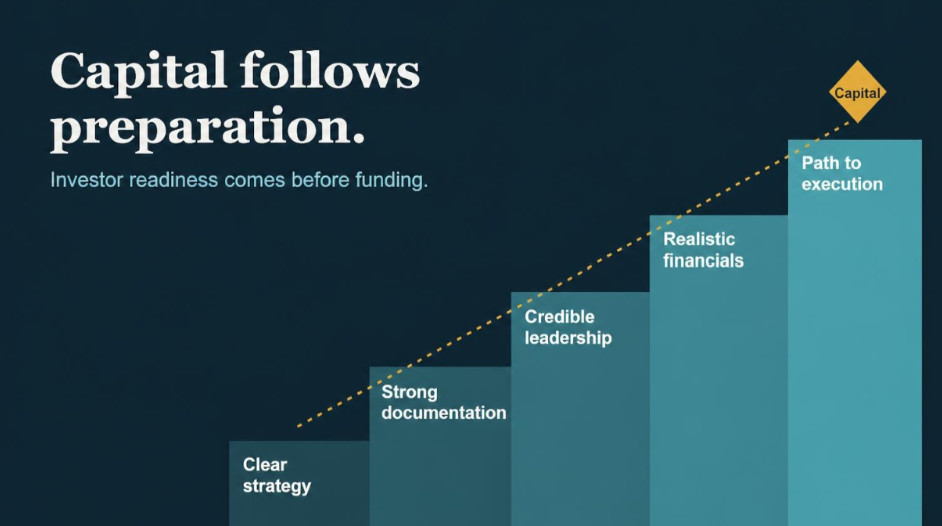
Mining Finance: Why Investor Readiness Comes First
Mining finance starts before investor outreach. Why investor readiness, a tested financial model and consistent documentation matter before a mining project meets investors.
Mining Investor Readiness: Evidence Before Capital Raising
Many mining projects reach investors before they are ready. Investor readiness means evidence an institutional reader can test, prepared before any approach to capital.

Mining industry trends in 2025: What investors and project leaders need to know?
Learn about the strategic crossroads, the crucial role of critical minerals, and the mounting ESG pressures