
Renewable Energy at Mine Sites: Economics and Bankability
Renewable energy at mine sites can reduce diesel exposure, improve energy resilience and support more bankable long-term mining operations.
Renewable energy at mine sites is increasingly driven by straightforward economics. Solar, wind and battery storage can reduce exposure to diesel prices, fuel transport, supply interruptions and emissions while giving mining companies greater visibility over long-term energy costs.
When I first wrote about this subject in 2019, Projects RH was seeing renewable generation being evaluated for mining operations in Australia, Asia and Latin America. At the time, the central question was whether renewable power at remote mines was principally a response to policy or whether commercial economics were becoming strong enough to drive investment.
The evidence is increasingly clear: policy can accelerate deployment, but economics, reliability and bankability determine whether a project ultimately works.
Renewable Energy at Mine Sites Is a Commercial Decision
Mining is energy intensive.
Remote operations can face an additional challenge because they may not have access to a large, reliable electricity grid. Historically, many such operations have relied heavily on diesel generation.
That creates several forms of exposure:
- fuel price volatility;
- long-distance fuel transportation;
- supply interruptions;
- logistics costs;
- storage requirements;
- maintenance;
- carbon emissions; and
- dependence on a single primary energy source.
Renewable generation can address several of these risks.
This does not mean that every mine should immediately replace conventional generation.
The correct energy solution depends on the resource, mine life, energy demand, location, operating profile, existing infrastructure and economics.
The investment case therefore begins with the mine, not the technology.
DeGrussa Demonstrated the Economics
One of Australia's most important early examples was the DeGrussa Copper-Gold Mine in Western Australia.
The Australian Renewable Energy Agency supported the development of a 10.6 MW solar photovoltaic system combined with battery storage at the remote mine.
The system included:
- 10.6 MW of solar PV capacity;
- 6 MW of battery capacity;
- integration with the existing diesel generation system; and
- a power purchase arrangement with the mining operation.
The project was commissioned in 2016.
According to ARENA, solar supplied a significant proportion of the mine's daytime electricity requirements and was designed to offset approximately 5 million litres of diesel annually.
The project also demonstrated that solar, batteries and diesel generation could operate together within an isolated industrial microgrid.
That was an important commercial milestone.
It moved the discussion beyond whether renewable power could technically work at a remote mine and toward how the technology could be integrated reliably into critical mining operations.
Financing Was Part of the DeGrussa Story
The financing structure is just as relevant as the engineering.
The Clean Energy Finance Corporation committed A$15 million to the DeGrussa Solar Project, while ARENA provided A$20.9 million in recoupable funding.
Total project cost was approximately A$40 million.
The renewable generation assets were developed separately from the mine itself, with Sandfire purchasing electricity under a power purchase agreement.
This illustrates an important principle for mining project finance.
A mining company does not necessarily need to own every energy asset serving its operation.
A suitably structured IPP or third-party ownership model can potentially separate:
- mine ownership;
- energy-asset ownership;
- operating responsibility;
- financing; and
- electricity purchasing.
The appropriate structure depends on the transaction, but separating energy infrastructure from the mining balance sheet can provide useful strategic and financial flexibility.
Power Purchase Agreements Can Support Bankability
A long-term power purchase agreement, or PPA, can be central to renewable energy financing.
For the mine, a PPA can provide greater visibility over future electricity costs.
For the power producer and its lenders, the agreement can provide contractual revenue.
However, a PPA is not automatically bankable.
Capital providers may examine:
- mine life;
- mine reserves and resources;
- offtaker credit quality;
- expected electricity demand;
- tariff structure;
- indexation;
- minimum purchase obligations;
- termination rights;
- curtailment;
- force majeure;
- security arrangements; and
- what happens if mining operations cease earlier than expected.
This creates an important relationship between geology and energy finance.
A 15-year energy contract is significantly more difficult to finance if the mine cannot demonstrate a credible operating life compatible with the contractual term.
The energy project therefore needs to be analysed within the commercial reality of the mine.
Renewable Energy at Mine Sites Requires Mine-Life Alignment
Renewable generation assets often have long operating lives.
Mines have finite resources.
If the renewable asset is financed on the expectation of long-term electricity revenues, lenders and equity investors need confidence that sufficient demand will exist throughout the financing period.
Depending on the circumstances, an energy asset could:
- serve more than one mining operation;
- connect to a regional grid;
- supply a local community;
- support nearby industrial users;
- operate under a shorter financing term;
- retain relocation possibilities; or
- receive additional contractual protection from the offtaker.
The solution is project-specific.
What matters is recognising mine-life risk before financing rather than discovering it during lender due diligence.
Batteries Change the Economics of Remote Power
At remote mines, solar generation alone cannot necessarily provide the reliability required for continuous industrial operations.
Battery storage changes the equation.
Batteries can perform several functions, including:
- smoothing variable renewable output;
- providing frequency support;
- reducing generator cycling;
- providing spinning reserve;
- improving power quality;
- shifting energy between periods; and
- supporting greater renewable penetration.
ARENA's DeGrussa project report documented the operational integration of the solar system with battery storage.
Mining operations require reliable power.
The investment question is therefore not simply how cheaply renewable electricity can be generated.
It is how the complete energy system can provide reliable electricity at an acceptable risk-adjusted cost.
Weipa Demonstrated Diesel Displacement
Rio Tinto's Weipa operations in Queensland provide another important example.
The original Weipa Solar Farm supplied renewable electricity into an existing remote power system under a long-term PPA.
ARENA expected the first stage to save up to approximately 600,000 litres of diesel per year.
This was commercially relevant for two reasons.
First, the project reduced direct exposure to diesel consumption.
Second, it demonstrated renewable generation operating alongside existing diesel generation in a remote mining environment.
Rio Tinto subsequently expanded renewable generation and storage at Weipa.
Rio Tinto Has Continued Expanding Renewables at Weipa
In 2023, Rio Tinto approved a further 12.4 MW solar farm and an 8.8 MVA/2.1 MWh battery system for its Amrun bauxite operations.
Rio Tinto expected the project to reduce Amrun's diesel electricity consumption by approximately 37% and annual CO2-equivalent emissions by around 14,000 tonnes.
Combined with the wider renewable power network at Weipa, Rio Tinto estimated diesel consumption would fall by approximately 10 million litres annually.
Remote renewable power is no longer simply a demonstration concept.
Mining companies are deploying increasingly sophisticated combinations of:
- solar;
- wind;
- batteries;
- conventional generation;
- microgrids; and
- contracted energy infrastructure.
The commercial question is increasingly how to optimise that combination.
Renewable Energy Can Improve Energy Security
Cost is not the only economic consideration.
Energy security matters as well.
Remote mines can be exposed to disruptions in fuel delivery. Flooding, road closures, logistics problems or other interruptions can affect diesel supplies.
ARENA has highlighted the role renewables can play in remote mining applications while reducing dependence on diesel and lowering emissions.
For a mine, lost production can be considerably more expensive than the direct cost of electricity.
Energy planning should therefore consider:
What is the economic value of reliable power to the mining operation?
That question changes how energy alternatives should be compared.
The cheapest nominal generation cost is not necessarily the best energy solution if it exposes the operation to unacceptable reliability risk.
Renewable Economics Have Strengthened
The economics of renewable technologies have changed substantially since the original article was published.
The International Energy Agency continues to track the deployment and competitiveness of clean-energy technologies.
Solar, wind and batteries are now deployed at significantly greater scale than when many early remote-mine renewable projects were conceived.
As technology costs decline and industry experience expands, projects that once required substantial demonstration support may become commercially viable under more conventional financing structures.
The Clean Energy Finance Corporation has highlighted how reductions in solar and battery costs, combined with increased industry experience, strengthened the commercial case for subsequent projects.
Economics Must Still Be Tested Project by Project
Falling technology costs do not mean every renewable mining project is automatically attractive.
Sponsors still need rigorous analysis.
A financial model should consider:
- renewable generation profile;
- mine load profile;
- diesel consumption;
- delivered diesel cost;
- network infrastructure;
- battery sizing;
- battery degradation;
- replacement CAPEX;
- operating costs;
- PPA price and indexation;
- mine life;
- residual asset value;
- financing costs;
- curtailment;
- carbon costs where relevant; and
- downside scenarios.
Sensitivity analysis is essential.
For example, what happens if:
- diesel prices fall;
- solar output is below forecast;
- the mine closes early;
- battery degradation exceeds expectations;
- construction costs rise;
- interest rates increase; or
- the mining operation needs more or less power than forecast?
The investment case should remain understandable under credible downside scenarios.
Renewable Power Can Affect Mine Competitiveness
Energy is not simply an environmental consideration for mining companies.
It is an operating cost.
For power-intensive operations, energy costs can materially affect:
- cash costs;
- operating margins;
- project valuation;
- reserve economics;
- expansion decisions; and
- competitiveness.
This is why renewable energy should be evaluated as part of the mine's wider economic model.
A lower and more predictable long-term energy cost can potentially support stronger operating economics.
But sponsors need evidence.
A theoretically low levelised cost of electricity does not, by itself, establish commercial value.
The relevant comparison is the total cost and risk of the alternative energy systems available to the operation.
Renewable Energy at Mine Sites and Project Finance
The energy transition introduces important financing considerations.
Investors financing a renewable asset associated with a mine need confidence in both projects.
They need to understand:
- the renewable asset;
- the mining operation;
- the contractual relationship between them;
- the creditworthiness of the mine owner;
- operating-life assumptions;
- energy-demand forecasts;
- technology performance;
- construction risk;
- permitting;
- security arrangements; and
- termination scenarios.
This means energy finance and mining finance cannot always be analysed independently.
A strong renewable project with a weak mining offtaker can be difficult to finance.
Likewise, a strong mining operation may still struggle to finance poorly structured energy infrastructure.
Bankability depends on the relationship between the two.
Investor Readiness Matters
For Projects RH, this leads directly to investor readiness.
A project seeking capital for renewable energy infrastructure should be able to present a coherent investment case.
Depending on the transaction, this may include:
- project ownership structure;
- renewable resource assessment;
- technical design;
- financial model;
- CAPEX and OPEX;
- PPA terms;
- battery assumptions;
- mine-life analysis;
- environmental approvals;
- construction strategy;
- counterparties;
- key risks;
- proposed financing structure; and
- expected investor returns.
Projects RH helps project sponsors strengthen financial positioning, financial modelling and investment documentation before serious capital outreach. Review our project finance and investor readiness services to understand the preparationbjective is not to remove every project risk.
The objective is to identify, quantify and allocate those risks in a form that investors and lenders can evaluate.
The Mining Energy Transition Is Accelerating
The direction of travel is increasingly visible.
New Australian projects are targeting substantially higher renewable penetration than early mine-site demonstration projects.
The Clean Energy Finance Corporation describes the Kathleen Valley Lithium Project as targeting renewable energy for up to 60% of its power requirements, supported by 46 MW of renewable-energy capacity and 17 MW of battery storage.
Renewable generation, battery storage and hybrid power systems are becoming increasingly significant components of mining infrastructure.
The economics, technologies and financing structures are continuing to mature.
Policy Helped Create the Market, Economics Will Scale It
Government institutions such as ARENA and the CEFC played important roles in demonstrating technologies and financing structures when mine-site renewables were relatively new.
That early support helped reduce uncertainty, created operational data and gave lenders, miners, developers and investors practical experience with technologies that had not previously been widely deployed together in remote industrial environments.
But widespread adoption requires more than policy support.
It requires projects that work commercially.
That means:
- competitive power costs;
- reliable supply;
- credible technology;
- strong counterparties;
- bankable contracts;
- appropriate financing; and
- alignment between asset life and mine life.
When these factors align, renewable power does not need to be justified solely as environmental policy.
It can be justified as infrastructure economics.
Sources
- ARENA - DeGrussa Solar Project
- ARENA - DeGrussa Solar Project Report
- ARENA - Weipa Solar Farm
- ARENA - Miners Rush to Renewables
- CEFC - Remote WA Mine Pioneers Solar and Storage
- CEFC - Liontown Resources Low-Carbon Lithium Production
- Rio Tinto - Amrun Solar Farm and Battery Storage
- International Energy Agency - Energy Technology Perspectives
Assess the Bankability of Your Mine Energy Project
If you are developing renewable generation, battery storage or hybrid power infrastructure for a mining operation, test the economics, PPA structure, risk allocation and bankability before approaching capital providers.
/intake.html to review the financial model, investment documentation, risk allocation and investor readiness before approaching the market.
/services.html for financial modelling, investor readiness, project finance and transaction preparation for mining and energy projects.
Paul Raftery
First published on ProjectsRH.com on 12 August 2019. Updated for accuracy, structure, readability and current mine-site renewable energy and project-finance context.

What to do next
Projects RH prepares the company and the project first, then takes them to investors. The fastest way to find out where you stand is a short call.
Keep reading
Metallurgical Testwork Mining Finance: Evidence Before Capital
Metallurgical testwork mining finance depends on recovery, variability, flowsheets and product quality. Learn what investors test before committing capital.
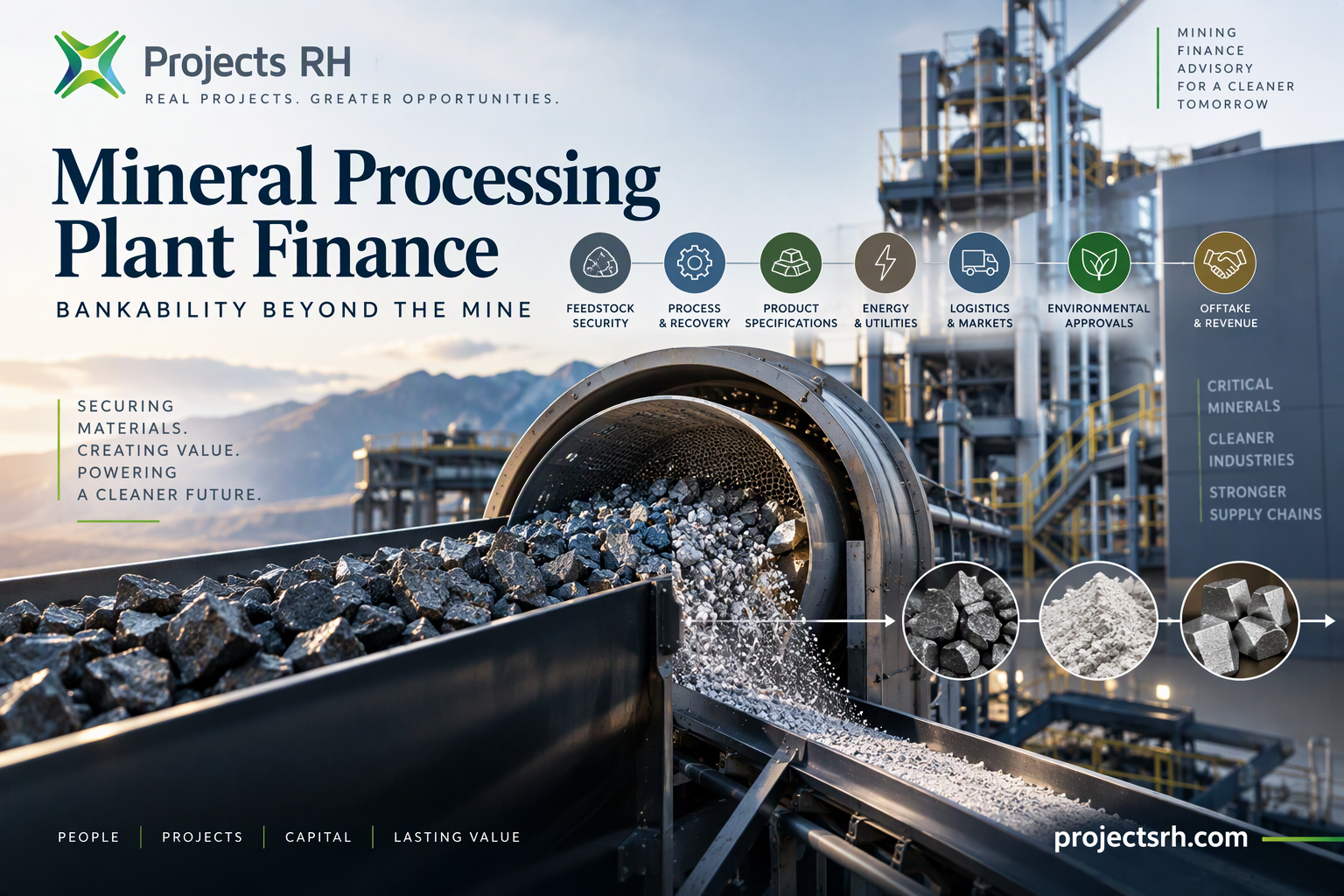
Mineral Processing Plant Finance: Beyond the Mine
Mineral processing plant finance depends on secure feedstock, proven recovery, saleable products, reliable energy, logistics, permits and credible offtake.
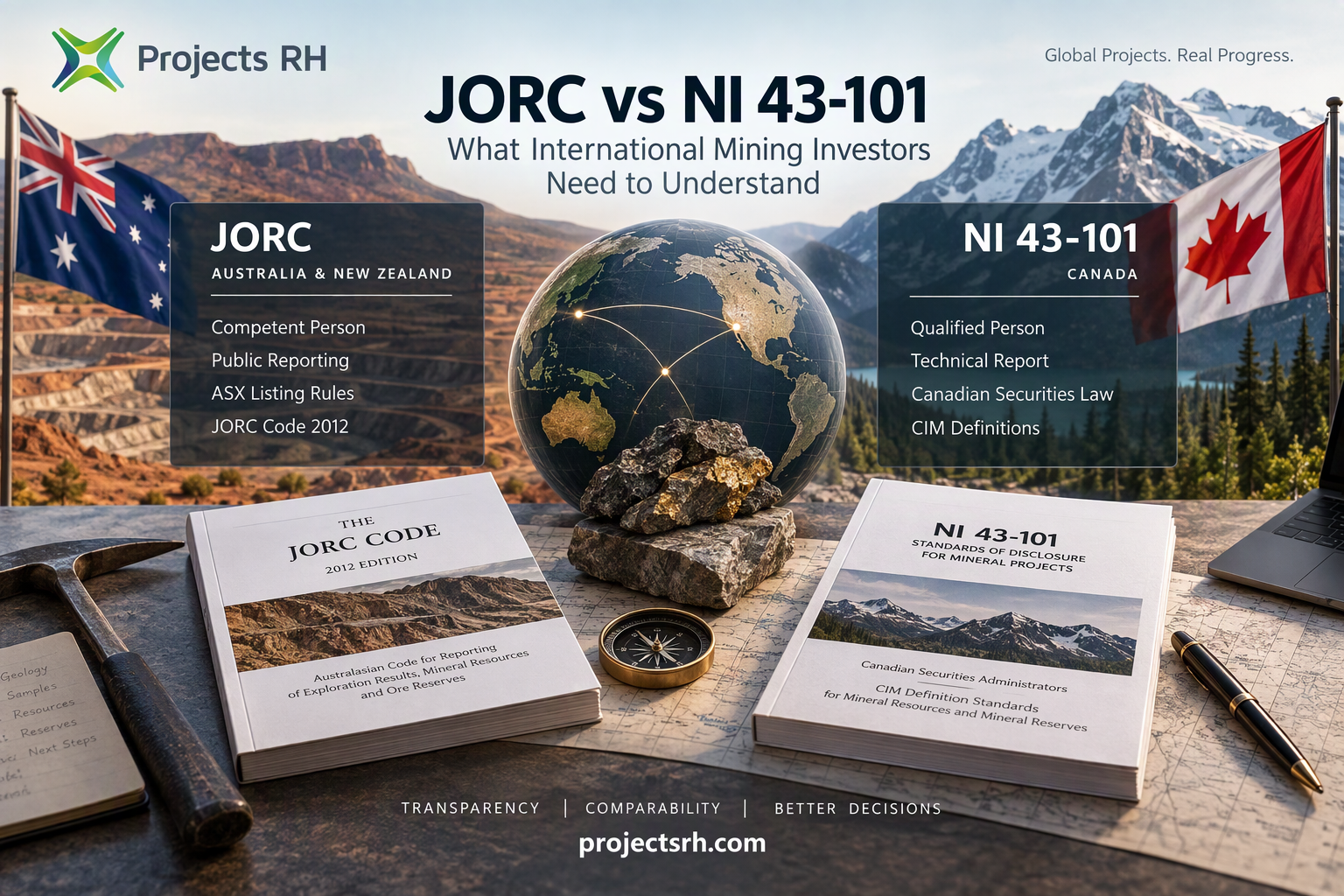
JORC vs NI 43-101: What Mining Investors Need to Know
JORC and NI 43-101 share resource categories but differ in legal status, expert responsibility, technical reporting and cross-border filing requirements.