
Renewable Energy Project Finance: How Projects Raise Capital
A strong resource is not enough. What investors and lenders assess in a renewable energy project, from revenue certainty and bankability to the model behind every figure.
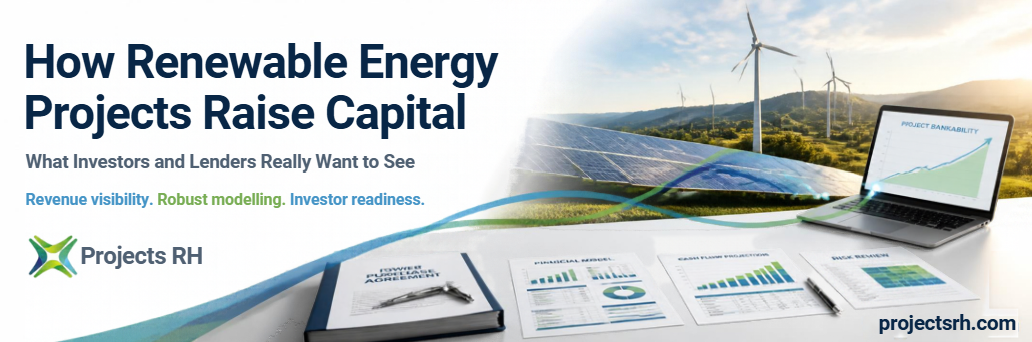
Renewable energy project finance depends less on the quality of a site than on the quality of its preparation. A strong resource, proven technology and a growing sector do not, on their own, bring investors. Projects raise capital through a combination of equity, debt and project finance. Capital providers assess whether a project can turn its resource, technology and operating plan into revenue and cash flow that are predictable enough to evaluate with confidence. For many sponsors, the gap is not the site. It is the preparation.
What investors ask of a renewable energy project
Before committing capital, investors and lenders want clear answers to a set of basic questions. Most fall under a few headings:
- Revenue: how the project will earn money, whether there is a Power Purchase Agreement (PPA) or another contracted mechanism, and who the offtaker is.
- Capital: how much is required, when it is needed and how the proceeds will be used.
- Delivery: whether the development and construction schedules are realistic.
- Resilience: whether cash flow can support the proposed debt, and what happens if costs rise, production falls or commissioning is delayed.
- People: whether management understands the project's economics and can defend them.
All of these questions lead back to one: can the project be evaluated with confidence? Professional investors generally expect a project to be substantially prepared before formal evaluation begins. By the time it reaches an investment committee, it should present a coherent investment case. That case should rest on credible financial information, consistent documentation and a defensible capital strategy.
Revenue certainty matters more than installed capacity
Developers naturally focus on megawatts. Capital providers focus on the cash flow behind them. A large project without a credible route to revenue may be harder to finance than a smaller one supported by a long-term contract with a creditworthy counterparty.
This is why offtake arrangements carry so much weight. In project finance, lenders generally look to the project's own future cash flows for repayment rather than to the sponsor's wider balance sheet. The contract terms therefore shape what can be borrowed.
A signed contract is not automatically a bankable one. Lenders will look at:
- contract duration, pricing and escalation
- contracted volumes and the treatment of curtailment
- termination rights and payment security
- exposure to merchant prices, including revenue after the contracted period ends
The question is whether the commercial arrangements produce a cash-flow profile that can be modelled, stress-tested and relied on when debt capacity is set.
Matching renewable energy project finance to the project's stage
Renewable energy projects are commonly funded through a mix of equity and debt. The sources depend on technology, jurisdiction, stage and risk. They can include sponsor and strategic equity, infrastructure funds, senior project finance debt, commercial bank facilities, private credit, development finance, green bonds and, in some markets, grants or concessional capital.
The structure should reflect where the project actually stands. Early development risk generally calls for more equity. A construction-ready project with permits, contracts and credible counterparties may be better placed to support debt. An operating asset with stable cash flow may reach a broader range of institutional capital.
So the first question is not how much can be raised. It is what type of capital the project can responsibly support at its current stage. A funding requirement is not the same as a funding strategy.
The financial model as the single point of truth
A common mistake is to treat the financial model as a document prepared only for fundraising. It should be the analytical foundation of the whole investment case. For a renewable project, it typically links:
- resource and production assumptions, availability and degradation
- development, construction, operating and lifecycle costs, including grid connection
- contracted and merchant revenue
- debt and equity contributions, debt-service capacity and reserves
The model should show how much capital is needed, when it is needed and how it will be deployed. It should also show when commercial operation is expected and whether cash flow can support the proposed financing.
It should then show what happens when things go less well. That means testing higher construction costs, a delayed grid connection, lower output, more curtailment, rising operating costs, a change in interest rates and weaker merchant prices.
An attractive projected return does not make a project credible. The return becomes credible when the assumptions behind it can be explained, evidenced and tested.
Projects RH treats the model as the single point of truth for every figure the other documents use. The information memorandum, investor deck, teaser and data room should all draw on the same numbers. A figure that differs between two documents invites doubt.
What makes a renewable energy project bankable
Bankability describes whether a project gives investors and lenders a credible enough basis to evaluate its risks, cash flows and expected returns. It does not mean eliminating risk. It means identifying the material risks, estimating their financial effect and showing how they are allocated or managed.
In practice, a bankable project will usually be able to show:
- secure land and development rights, and the permits it needs
- a realistic construction programme and grid-connection readiness
- contracted or defensible revenue, with creditworthy counterparties
- reliable construction and operating partners
- transparent modelling and experienced management
Lenders will also look at coverage ratios such as the Debt Service Coverage Ratio. They will examine how construction risk sits within the engineering, procurement and construction arrangements, and review operations and maintenance agreements, security arrangements and completion support.
Many projects that struggle do so for reasons that could have been found earlier. These include unrealistic revenue assumptions, incomplete capital cost estimates, unresolved grid requirements, optimistic schedules, debt sized only on the base case, figures that differ between documents, and management that cannot defend its own assumptions. The problem is often not the technology or the market. It is the preparation.
Investor readiness comes before capital raising
Many sponsors start by asking where to find investors. The more useful question is whether the project is ready for them. Before approaching funds, lenders, development finance institutions, family offices or strategic investors, management should be able to explain what is being developed and who owns and controls it. It should also be able to say what stage the project has reached, how much capital it needs and when, how revenue will be earned, what the principal risks are and how the project performs under downside conditions.
Investor readiness does not guarantee investor interest, valuation, funding, timing or completion. It means that management has identified the material issues and organised its information. It also means management has a reasonable basis for answering the questions a professional investor or lender will ask.
What you can do next with Projects RH
Projects RH establishes the facts, builds or tests the model and prepares institutional documentation. If you are developing a solar, wind, storage or other renewable energy project and want to know what an institutional reader would mark, there are practical first steps:
- Book a complimentary 20-minute discovery call. There is nothing to prepare.
- Send the documents you already have. A person at the firm reads them and replies in writing within 3 business days. No confidentiality agreement is in place at that point. If your documents are confidential, ask for the firm's agreement first and send them once it is accepted.
- Consider the Investment Readiness Assessment. If you go ahead, it gives you a written Preliminary Readiness Profile, a gap analysis and a recommended preparation package.
Preparation produces a financial model, an information memorandum, an investor deck, a teaser and an organised data room, each reviewed by a professional.
Capital raising is separate. It happens only under a separately accepted mandate, which can be declined, and nothing in it is guaranteed.
You can read how the five steps work, with a decision at the end of each.

What to do next
Projects RH prepares the company and the project first, then takes them to investors. The fastest way to find out where you stand is a short call.
Keep reading
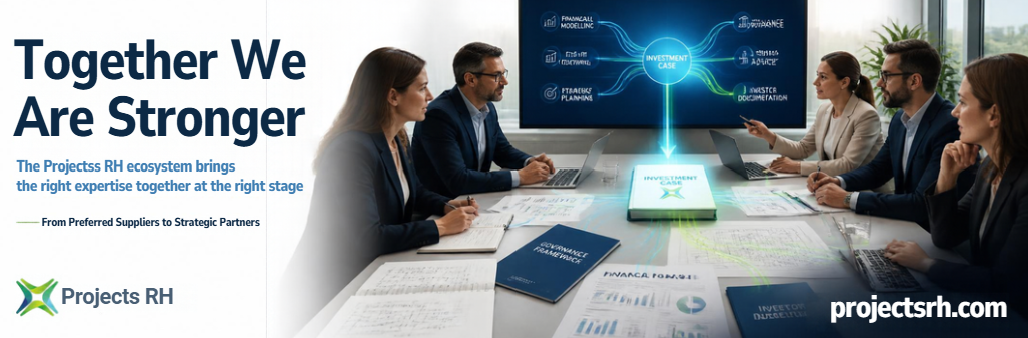
Capital Raising Partners: Why One Coordinated Case Matters
Capital raising draws on many disciplines. How Projects RH works with strategic partners on one coordinated investment case, and the two rules every referral follows.
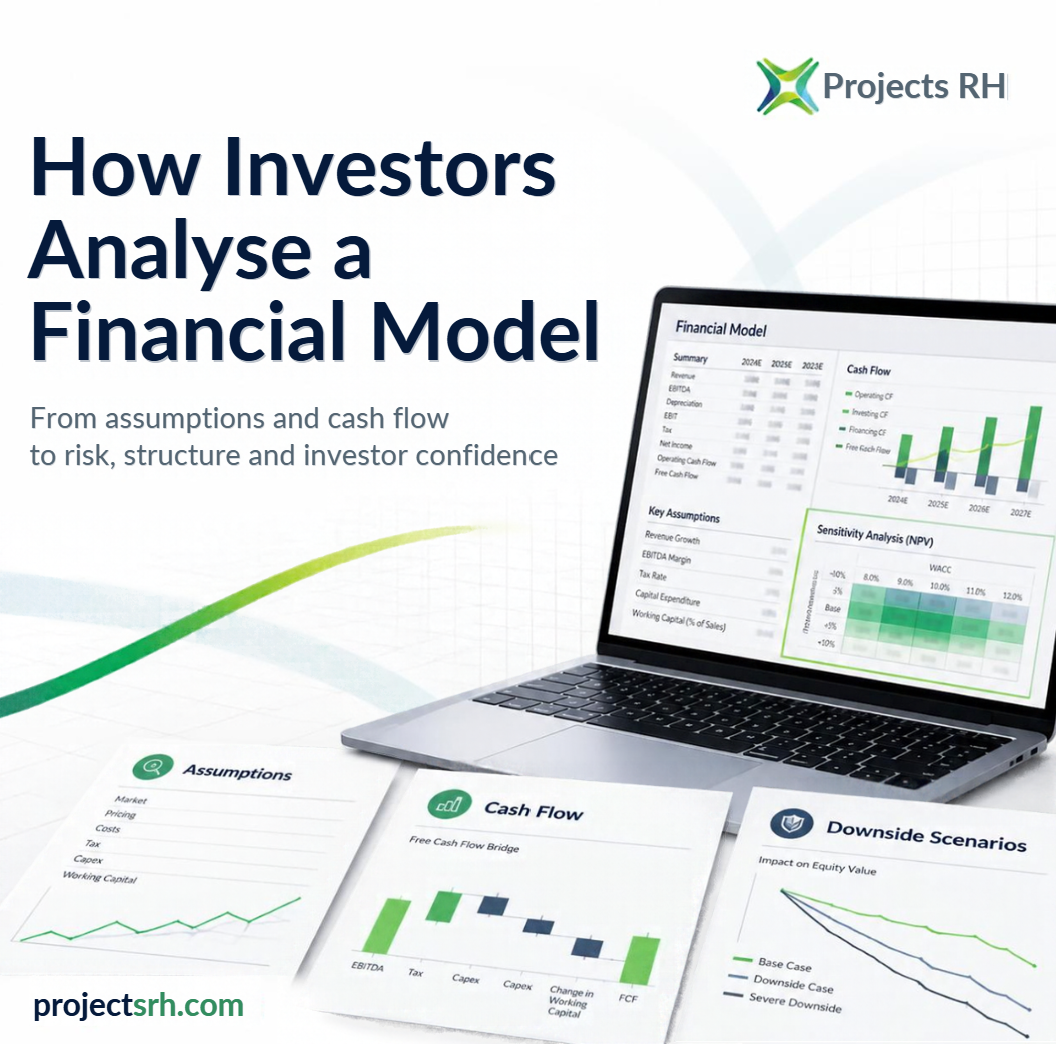
How Investors Analyse a Financial Model, and What They Test
Investors test assumptions, cash flow, mechanics and capital structure before returns. What they look for in a financial model, and what an investor-ready model must show.
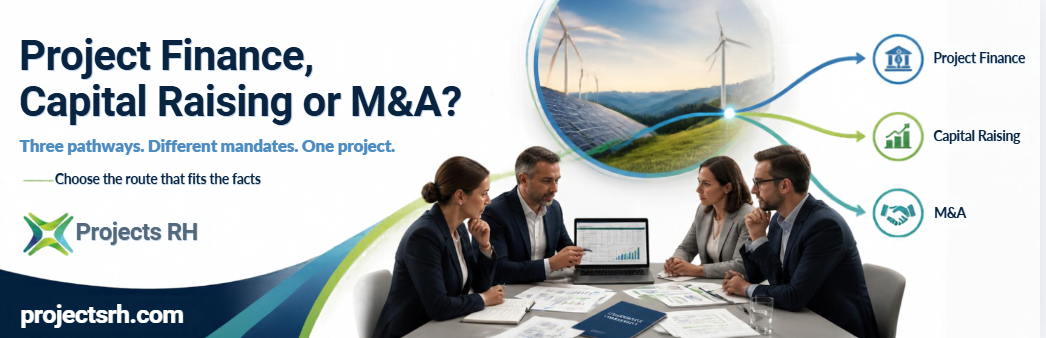
Understanding Project Finance for Capital-Intensive Projects
Project finance is one way to fund a capital-intensive project. Here is how it differs from capital raising and M&A, and why each pathway sits under its own mandate.