
Economics of Anaerobic Digestion: Costs and Returns
Explore the economics of anaerobic digestion, including CAPEX, OPEX, revenue, feedstock, biomethane, project finance and investor readiness.
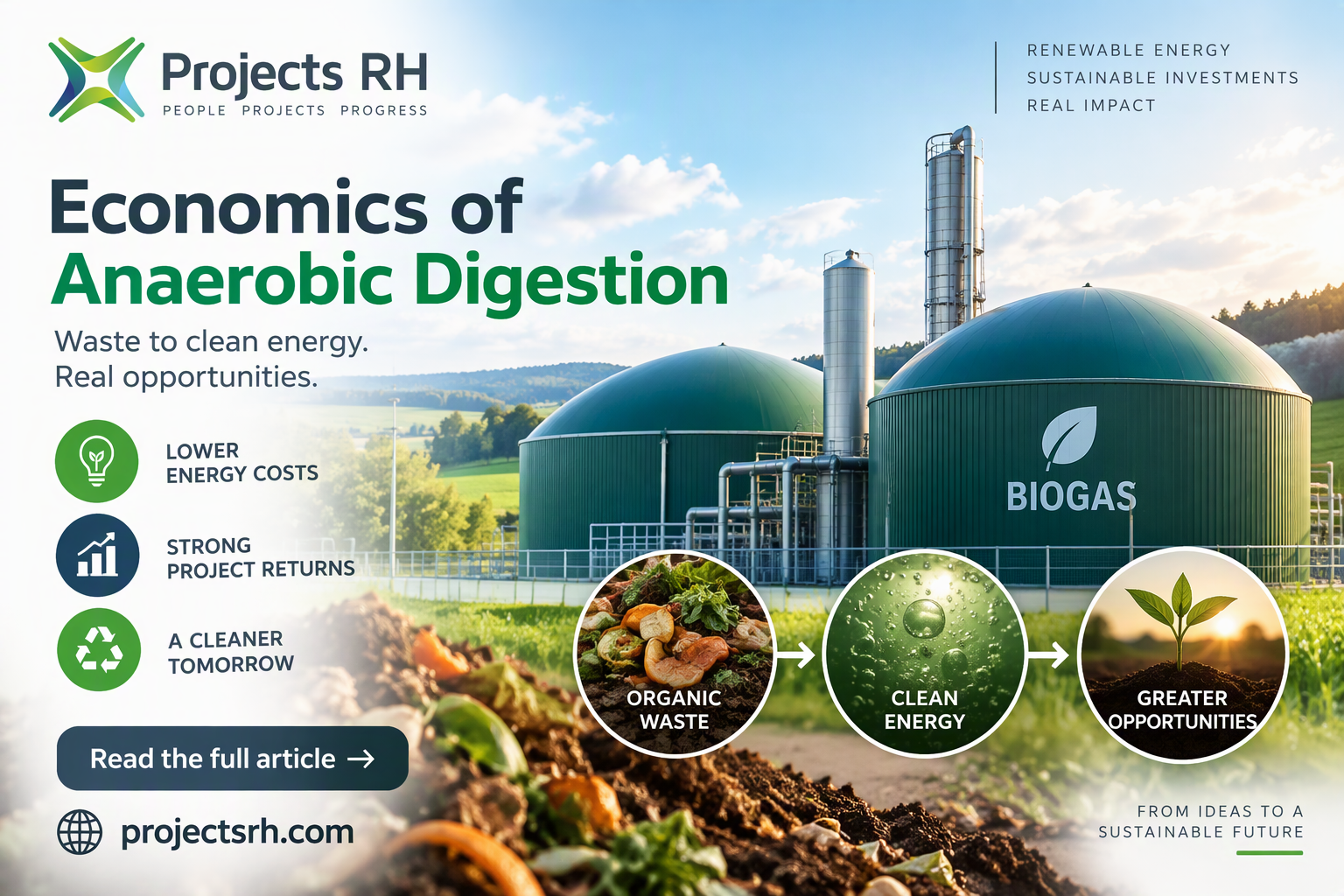
Economics of anaerobic digestion depend on much more than the cost of building a digester. Feedstock security, biogas yield, plant availability, energy prices, biomethane upgrading, digestate management, incentives, financing and long-term offtake arrangements can all determine whether an anaerobic digestion project becomes commercially viable and investment-ready.
For project developers and investors, the central question is not simply whether anaerobic digestion works technically. It is whether the project can convert organic waste into predictable cash flow while managing construction, operational, feedstock, market and regulatory risks.
Economics of anaerobic digestion: What drives project viability?
Anaerobic digestion (AD) breaks down organic material in the absence of oxygen and produces biogas, principally methane and carbon dioxide, together with digestate.
The commercial model depends on how those outputs are used. Biogas can support heat, electricity or combined heat and power (CHP), while upgraded biogas can become biomethane, also known in some markets as renewable natural gas (RNG).
The International Energy Agency identifies biogas and biomethane as potential contributors to energy security, waste management and emissions reduction. Its analysis also demonstrates how strongly project economics can depend on geography, feedstock availability and access to infrastructure.
For developers, this means an AD project's economics should be evaluated as an integrated system rather than simply as an energy-generation asset.
Main revenue streams in an anaerobic digestion project
A viable AD project may combine several sources of revenue and cost savings.
Energy and biogas revenue
Biogas can potentially be:
- Used for onsite heat
- Converted into electricity
- Used in combined heat and power systems
- Upgraded into biomethane
- Injected into a gas network where infrastructure and regulation permit
- Used as a transport fuel in appropriate markets
The U.S. EPA AgSTAR program identifies biogas sales and avoided electricity and heating costs among potential revenue sources for AD projects.
The value of the energy therefore depends on the selected route to market. A project selling renewable electricity under a contracted tariff has a different financial profile from a facility selling biomethane into a gas network or using biogas internally to offset purchased energy.
Tipping fees and waste management revenue
Some projects may generate income by receiving organic waste that would otherwise require disposal or treatment.
This can create an additional revenue stream alongside energy production. However, the economics depend on local waste markets, transport distances, feedstock quality, contamination risk and contractual arrangements.
Digestate
Anaerobic digestion produces digestate containing nutrients that may have agricultural value.
Whether digestate represents a revenue stream, an avoided fertilizer cost or an additional management expense depends on its quality, applicable regulation, storage requirements, nutrient demand and distance to suitable end users. Developers should therefore model digestate conservatively rather than automatically treating it as a high-value revenue source.
Environmental attributes and incentives
Depending on jurisdiction and project configuration, AD projects may benefit from renewable energy certificates, low-carbon fuel programs, grants, tax incentives or other environmental attributes.
These mechanisms can materially influence project economics, but they are market-specific and can change.
For that reason, incentives should normally be modeled separately from core operating revenues so investors can understand how the project performs both with and without policy support.
Key costs in anaerobic digestion projects
There is no reliable universal CAPEX figure for anaerobic digestion.
Cost depends on scale, feedstock, engineering design, gas use, upgrading requirements, interconnection, storage, permitting and site conditions.
Capital expenditure
Typical CAPEX categories can include:
- Feedstock reception and preprocessing
- Digester vessels
- Heating and mixing systems
- Gas storage
- Gas cleaning
- Biomethane upgrading equipment
- Combined heat and power equipment
- Digestate treatment and storage
- Electrical or gas-grid interconnection
- Civil works
- Engineering and construction
- Monitoring and control systems
- Development and permitting
- Contingency
The economics should therefore be based on a project-specific capital budget rather than a generic cost assumption.
Operating expenditure
OPEX may include:
- Labor
- Maintenance
- Feedstock handling
- Utilities
- Biological monitoring
- Consumables
- Insurance
- Digestate management
- Equipment replacement
- Gas upgrading
- Transport
- Regulatory compliance
These costs should be modeled across the life of the project and stress-tested for inflation and operational variability.
Feedstock can determine the business model
Feedstock availability is one of the most important economic variables in an anaerobic digestion project.
Potential sources include:
- Livestock manure
- Crop residues
- Food-processing waste
- Municipal organic waste
- Wastewater sludge
- Other suitable organic residues
The IEA's global assessment of biogas and biomethane identifies substantial sustainable potential from manure, crop residues, biowaste and other feedstocks.
Feedstock economics, however, depend not simply on quantity but also on:
- Collection distance
- Seasonality
- Moisture content
- Methane yield
- Contamination
- Competing uses
- Transportation cost
- Contract duration
- Ownership and pricing
An investor-ready project should therefore demonstrate not only that feedstock exists, but that sufficient feedstock can be secured economically for the required operating period.
Biogas versus biomethane economics
The optimal use of biogas varies between projects. Direct use for heat or CHP may offer a comparatively straightforward route where there is suitable onsite demand.
Upgrading biogas into biomethane introduces additional capital and operating costs but can provide access to different markets and potentially higher-value uses.
Infrastructure access also matters. The proximity of electricity grids, gas pipelines, roads and end users can materially change development costs, operating costs and commercial options.
Project developers should therefore compare alternative routes to market rather than assuming that the highest-value end product will automatically produce the strongest investment return.
Financial modelling for anaerobic digestion
Financial feasibility assessment should follow technical feasibility rather than precede it.
The U.S. EPA AgSTAR program describes AD financial feasibility assessment as an iterative process. Developers first consider site and technical feasibility, then estimate revenues and expenses, refine assumptions and evaluate financing and owner/operator structures.
A robust financial model should typically consider:
- Feedstock volumes
- Feedstock cost or tipping-fee revenue
- Biogas yield
- Plant availability
- Electricity, heat or biomethane production
- Energy sales price
- CAPEX
- OPEX
- Construction timetable
- Financing structure
- Interest rates
- Tax assumptions
- Incentives
- Digestate economics
- Working capital
- Debt service
- Free cash flow
- Internal Rate of Return (IRR)
- Net Present Value (NPV)
Sensitivity analysis is particularly important.
Potential downside cases can include lower gas yield, reduced plant availability, construction overruns, delayed commissioning, higher operating costs, lower energy prices or changes to incentive structures.
What makes an anaerobic digestion project investment-ready?
Technical potential alone does not make a project financeable.
Before approaching investors or lenders, developers should be prepared to demonstrate:
- Feedstock security: quantity, quality, location and contractual availability.
- Technology: proven process design appropriate for the selected feedstock.
- Site control: adequate rights over the proposed development location.
- Permitting: a clear regulatory and environmental approval pathway.
- Offtake: credible routes to monetize electricity, heat, biogas or biomethane.
- CAPEX: supported development and construction assumptions.
- OPEX: realistic long-term operating costs.
- Financial model: transparent assumptions, sensitivities and funding requirements.
- Project team: credible technical, commercial and financial delivery capability.
- Risk allocation: clear responsibility for construction, feedstock, operations and market risk.
This broader investor readiness process helps determine whether a project is ready for serious discussions with professional capital providers.
For a broader overview of the Projects RH process, see How Projects RH Works.
Financing anaerobic digestion projects
AD projects can potentially use different combinations of equity, debt, grants, strategic investment and project finance depending on their development stage, geography, contracts and risk profile.
The financing structure should reflect where the project sits in its development lifecycle.
Early development capital may fund:
- Feasibility work
- Engineering
- Feedstock studies
- Environmental studies
- Permitting
- Financial modelling
- Commercial agreements
Construction capital requires considerably greater certainty around project cost, schedule, feedstock, technology, contractual arrangements and projected revenues. An Information Memorandum can bring these elements together for professional investors and lenders, supported by the underlying financial model and appropriate due diligence materials.
The objective should not simply be to [find investors] (https://projectsrh.com/insights/how-do-i-find-investors). It should be to prepare a project that appropriate investors and lenders can evaluate efficiently.
Risks that can change anaerobic digestion economics
Feedstock risk
Changes in feedstock quantity, quality or acquisition cost can materially affect energy production and cash flow.
Long-term supply arrangements and diversified feedstock strategies may reduce this risk where technically appropriate.
Construction risk
Cost overruns and commissioning delays can increase funding requirements and postpone revenue generation.
A credible project budget should include appropriate contingencies and clearly identified construction assumptions.
Operating risk
Digester biology, maintenance, equipment availability and gas yield influence production.
Financial models should therefore avoid assuming perfect plant availability or uninterrupted production throughout the project life.
Energy price and offtake risk
Merchant energy prices can introduce significant revenue volatility. Where appropriate, long-term offtake arrangements may provide greater revenue visibility, although contract terms and counterparty creditworthiness also matter.
Regulatory risk
Waste regulation, gas standards, environmental approvals, grid requirements and incentive regimes vary significantly between jurisdictions.
Developers should therefore verify applicable regulatory requirements in every jurisdiction where a facility is proposed.
The outlook for biogas and biomethane
The long-term opportunity for biogases is significant.
The International Energy Agency estimates substantial sustainable global potential for biogas and biomethane and identifies technological learning, improved yields and economies of scale as important factors for future development.
However, theoretical potential does not automatically translate into an investment-ready project.
Commercial deployment still depends on feedstock concentration, infrastructure, market access, regulation, project execution and the ability to structure a credible investment proposition.
This distinction matters for project developers and investors alike.
FAQ: Economics of anaerobic digestion
What determines the economics of anaerobic digestion?
The economics of anaerobic digestion depend primarily on feedstock, biogas yield, plant scale, CAPEX, OPEX, utilization, energy or biomethane pricing, digestate management, incentives, financing costs and the reliability of long-term commercial arrangements.
Is anaerobic digestion profitable?
Anaerobic digestion can be commercially viable, but profitability is project-specific. A credible assessment requires technical feasibility, project-specific revenues and costs, realistic financing assumptions and sensitivity analysis rather than a universal payback estimate.
What are the main revenue streams from anaerobic digestion?
Potential revenue streams include electricity, heat, biogas or biomethane sales, tipping fees, digestate products and, in some jurisdictions, environmental attributes or policy incentives.
What is the difference between biogas and biomethane?
Biogas is produced during anaerobic digestion and primarily contains methane and carbon dioxide. Biomethane is produced by upgrading biogas to remove carbon dioxide and other impurities, creating a gas that can substitute for natural gas where applicable quality and infrastructure requirements are met.
What do investors look for in an anaerobic digestion project?
Professional investors typically need evidence supporting feedstock availability, technology, site control, permits, CAPEX, OPEX, offtake, management capability, financial assumptions and key project risks before determining whether further due diligence is justified.
How should an anaerobic digestion project prepare for capital raising?
Preparation should begin with technical and commercial feasibility, followed by a robust financial model, supported assumptions and institutional-quality investor documentation. Material project gaps should be identified and addressed before approaching potential capital providers.
Sources and further reading
- International Energy Agency: Outlook for Biogas and Biomethane
- International Energy Agency: Key Findings on Biogas and Biomethane
- U.S. EPA AgSTAR: Biogas Recovery in the Agriculture Sector
- U.S. EPA AgSTAR: Project Planning and Financing
Related Projects RH insights
- Investor Readiness: What Investors Test Before They Commit
- What Is an Information Memorandum?
- How Do I Find Investors?
- How Projects RH Works
Is your anaerobic digestion project ready for capital?
Strong anaerobic digestion economics begin with more than promising technology. Investors need to understand feedstock security, project costs, revenue assumptions, execution risk and how the proposed capital will move the project toward commercially viable operation.
Projects RH helps project sponsors establish the facts, build or test the financial model, identify investor-readiness gaps and prepare institutional-quality investment documentation. Capital raising follows only where appropriate under a separate mandate.
Developing a biogas, biomethane or anaerobic digestion project? Book a complimentary 20-minute discovery call with Projects RH to discuss your project's investor readiness and financing strategy.

What to do next
Projects RH prepares the company and the project first, then takes them to investors. The fastest way to find out where you stand is a short call.
Keep reading
What Is Biogas? A Complete Guide to Renewable Energy
What is biogas? Learn how organic waste becomes renewable energy, how biomethane is produced, its uses and what investors assess before financing a project.

How Can Waste Products Be Used as a Renewable Resource?
How can waste products be used as a renewable resource? Explore biogas, recycling, waste-to-energy and what makes resource-recovery projects investable.
Is Anaerobic Digestion Profitable? Costs and Returns
Is anaerobic digestion profitable? Learn how feedstock, CAPEX, OPEX, biogas revenue, biomethane, offtake and financing determine project returns.